Saturday, December 11, 2010

Artisan Bread


A loaf of Artisan bread I just pulled out of the oven, I made 2 loaves today the first one is already gone.  I have enough dough left to make bread for the next week. This is the easiest no knead bread recipe.   You can make fresh homemade bread everyday and fill your home with the smells of a bakery.

Artisan Bread in Five Minutes A Day

Friday, December 10, 2010

Meet Peppermint Our Angora Rabbit


Last year for Christmas we gave Tessa her own angora rabbit, and she named her Peppermint. She has been a wonderful addition to our rabbit herd, angora's really loves to be pampered and paid attention to.  They need to be thoroughly brushed at least once a week  they really love this ritual , and on nice days we let her out in the garden ...with constant supervision, so she can run and play while I'm working.  All the rabbits like to get out and stretch their legs, they run and leap in the air they're so happy.  One of my goals this Spring is to create a rabbit/chicken tractor, something so they can be safe and contained in, and yet free to eat grass and weeds, and dig in the dirt. I'm planning to rotate and share it with the chickens too.

Rabbits love to dig for roots, they like dandelion greens, and various other grasses and weeds.  We regularly pick good stuff for them to eat around the yard, and add it to to their diet.  I have had the opportunity to study rabbits in the wild, and what the like to eat.  Our mini rex's had some babies in the wild, and the ones not born in cages, but in the wild have survived.  We still have a wild one come every morning  to the rabbit hutches, and visits with them.

Peppermint got loose one time last year, we had a frantic search for her until dark.  In the morning thankfully I found her sitting under a tree with the wild rabbit right beside her.  I could tell she was glad to be found, and back home. This was a happy ending. 

We clip her angora fiber about every 3-4 months depending on the time of year.  So far I have not learned to spin it yet, so we've been gathering and saving her beautiful fur for the time when we will spin it, and knit hats, and scarves maybe even a sweater.   My daughter Tessa and I learned to knit over the holidays last year so we could make stuff with her fiber.  They say that you should be able to get enough fiber from one rabbit to knit a sweater every year.  Angora rabbits are a fun addition to a farm, we are planning to breed her this Spring, and will add one of her babies to our herd.

Thursday, December 9, 2010

Chicken Coop

Home Grown Meat

I have a confession to make, I have never actually killed a chicken or  a rabbit or any animal for food.  I seriously don't know how I ever will, but know I probably will at some point... learn...maybe.  Even our brave and fearless captain Jarin also has no desire to do the deed (even growing up the son of a butcher).  So my son  who is 15 decided it was up to him if it was ever to get done, and so he does it.  He brings it to me skinned, and I cook it.   He tans the hides, and makes beautiful rabbit furs.  I have never asked him to do this, he has studied my Back to Basics book, read how, and just does it.  I had a serious talk with him about giving honor to the animal, being conscious in your heart, and thanking them for giving us life and sustenance.  I believe there should be a certain reverence for these animals that we have loved and nurtured.  It should always be done quickly, humanely, and never where another live animal can see it.

We have only just started doing our own home grown meat in the last few months.  Of the rabbits he has done 4 of them, bucks just at maturity, and a couple of   1 1/2 year old does.  He did them 2 at a time on different occasions, and never told me he was going to do it until after the fact.  He knew I would have a really hard time with it, as these were raised from birth at our farm.  The feed store that bought several litters over the summer, did not want  to take anymore because of the time of year and going into winter.  When you only have 4 rabbit cages, this naturally keeps your numbers in check.

In the early Fall he processed our first young rooster from our first batch of chicks that one of our sitting hens hatched out in the spring.  My mom couldn't believe we would eat our animals, she had seen them as young chicks, and knew how much they all meant to me.  I couldn't believe I was eating our animals either, but that's what you do when you truly want to be self sufficient if you want to eat  meat, something has to die, this is hard thing to do.

I think the first few animals you ever kill are the hardest, even though I didn't actually do it.  I cooked and ate them... I had never tasted rabbit before in my whole life, and boy let me tell you was it ever good!  I was sold, and now understood why the French and much of Europe adore cooked rabbit.  Jason got to choose how he wanted it cooked since he did the deed.  I  baked 2 at a time, and made rabbit pot pie, in my extra large double pie plate.  Vegetables, rabbit and a top crust taste unimaginably good!  So he wanted it done the same way the next time, we all did, everyone except our 13 year old daughter Tessa, she never could bring herself to eat any of it, and claimed she'd be a vegetarian for the night.  Fortunately she did get over it in time for the rooster, and baked chicken, and soup, this was something she was used to eating.  I am trying to teach my children where their food comes from, this is important to me.

Wednesday, December 8, 2010

Cutting down the Christmas Tree


Yesterday was the day we decided to cut down our Christmas tree.  Since we live in an old Christmas tree farm we just go out in the forest and  look for a great tree at the top, the trees are rather large so taking off the top portion is the right size for a large tree.  We had to fill in the gaps between some of the branches that were sparse by drilling holes and placing the branches to look fuller.  We are in frugal mode, so it  feels good to save the money on buying a tree.  We have gone to u cut lots, and spent $35-50 on a nice tree.   This year is different...neither one of us have a formal job, we are having to be very scrappy to survive the winter, and the holidays.   This will be a handmade Christmas like no other. 

We all pulled out the tupperware boxes of Christmas decorations from the basement, and began setting the memorabilia out.  Some things have been with us for a long long time, and are like old friends when you pull them out of the boxes.  We will be putting on the lights and decorating the tree tonight.  I have planned turkey noodle soup for dinner, with homemade noodles.  I also have the movie "The Santa Claus" pulled out to watch as a family.

Peanut Butter Cookies


At least once a week I make cookies,  if I get to vote usually I make peanut butter, Tessa likes oatmeal raisin, Kaley likes chocolate chip, Jason and Jarin like all of them.   so last night after we got the tree set up in the stand  I made another batch of  peanut butter cookies.  This is what was left after everyone ate their fill after supper.

Here's the best PB Cookie recipe I've been regularly making them for years.


Peanut Butter Cookies

2 1/2 cups all purpose flour ( I usually do half whole wheat)
1/2 tsp baking soda
1/2 tsp baking powder
1/2 tsp salt
2 sticks butter
1 cup brown sugar firmly packed
1 cup sugar ( I usually do half or 3/4)
1 cup extra crunchy peanut butter (any kind)
2 large eggs
2 tsp vanilla extract
1 cup roasted salted peanuts, ground in food processor to resemble bread crumbs. (sometimes if I don't have any peanuts I just add more peanut butter)

Oven 350 degrees. 
1.  Sift flour, baking soda, and salt in medium bowl.
2.  In bowl of electric mixer or by hand, beat butter until creamy.  Add sugars; beat until fluffy, about 3 minutes, stopping to scrape down bowl as necessary.  Beat in peanut butter, then egg's, one at a time, then vanilla.  Gently stir dry ingredients into peanut butter mixture.  Add ground peanuts stir gently until just incorporated.
3.  With 2 tablespoons dough at a time roll into large balls, placing them 2 inches apart on a parchment covered cookie sheet (If I don't have parchment, I just grease a cookie sheet), press dough with back of dinner fork dipped in cold water to make criss cross design.  Bake until cookies are puffed and slightly brown along edges, 10-12 minutes.

yum, enjoy!

Tuesday, December 7, 2010

The Barn

The first part of the Barn was built in 1976, when Jarin was 26 years old.  It's built using the beam and bolt style of building, this was before he began to specialize in timber framing.  Over the years he's added onto the back, sides and front of the barn.  There was never any finish put on, and we have just let it age naturally. I have dreams of  it beautifully finished with Sierra Penefin, maybe someday.   Much of the Barn was built from trees he cut and milled right on our property, along with recycled old growth beams. If you have lots of trees on your property for building, you are rich indeed. If you only have a few...don't cut them down! They are worth more for their beauty and the enjoyment of seeing them alive. We have an abundance of evergreen Douglas Fir trees on our ten acres, and the trees for buildings came from clearing the meadows. Our friend Matt has a Wood Mizer mill that he brings out to our home, it's worth every penny to have him come out.  When he leaves we have a wonderful pile of large timbers and lumber, and after curing and drying it will be perfect for building economically. 


The workshop where all the big tools are for building timber frames and various carpentry projects.  The desk and drawing table are for Jarin the artist/architect and his drawings of barns, cabins, bungalows, gazebo's and gates. Our Barn is very cozy upstairs in the living quarters, I just love it.  It feels like a squirrel nest in the evening with the glow of soft light, the smell of good food cooking, and the warmth of family.


In the beginning there was no running water or bathroom in the barn, we did have to 2 finished bathrooms a short walk over to the Cabin and Big House. The Big house is where we all took our outdoor showers, and did our laundry. I will write more about the Big House and Cabin in another post, along with pictures. 

Running water is so essential for a family!!! You really appreciate it after hauling water. We also built 2 loft bedrooms, they are warm with the heat that rises. The first few winters living here, we stayed close to the wood stove it was so cold.  The kids never got up until they heard the crackling of the fire that I would start before anything else in the morning. We still out of habit stay close to the woodstove, even though now the barn is much warmer. 
There is off to one side of the barn 3 rooms ( they house my office, and 2 of the childrens rooms). At the back of the barn is a shorter loft that is our book nook/ library. The other side of the barn is the kitchen, bathroom and pantry. About 4 years ago we put up plywood over the insulation, and built shelves, and room dividers. We also insulated the bottom of the barn, so cold air couldn't come through the cracks, this made a huge difference in our warmth factor.
The first thing we did was get the barn connected to it's own septic system, then installed plumbing, a bathroom and a rustic kitchen.

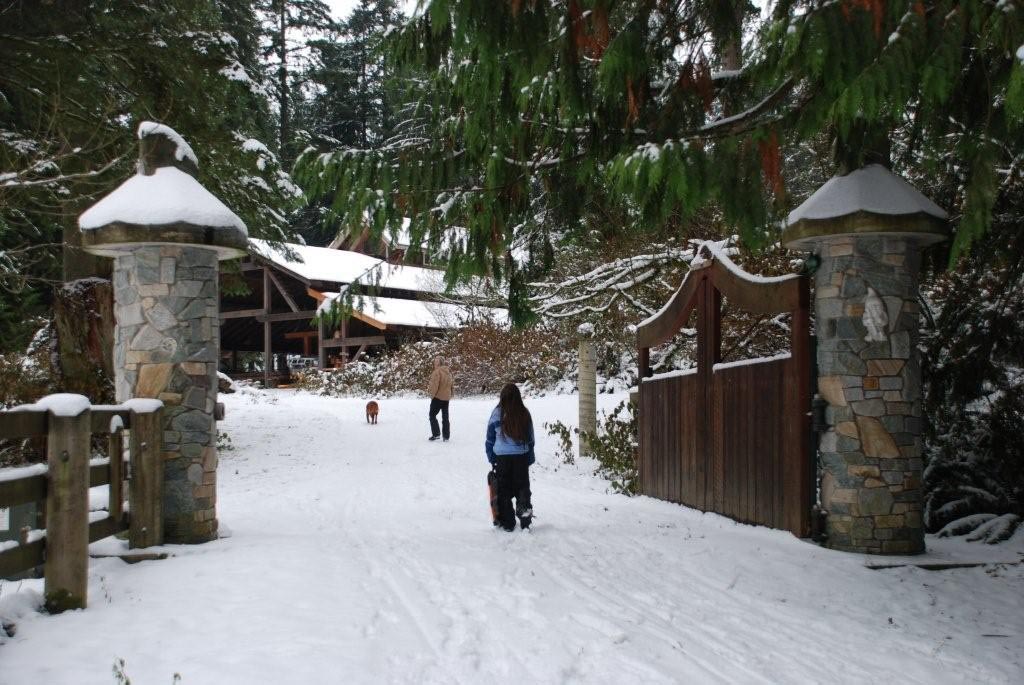
This is the gate leading into Applegarth Farm.  Jarin built it when we got together, and told me that this was the storybook gate, for the beginning of our life and story as a family.

Sunday, December 5, 2010

Farm and Garden


Meditating in the garden...This time of year as everything has totally died back, I enjoy looking at pictures from the summer and fall.  And I begin to dream about my garden coming back to life in the spring. 


Notice "Sierra" our great pyrenees laying down looking out of her new pasture.  This is the entry gate that Jarin built in October for her new 1 acre pasture.  She is 1 year old purebred Great Pyrenees. and if let loose will wander off  and explore for miles around.  She will return, but the responsible owners of this breed will understand the need to be fenced or on lead, until they are mature enough to not want to wander, this may take 4 or 5 years.  They are wonderful livestock guardian dogs, when they are fenced with the animals.  This is my my husband Jarin's dog, and she goes everywhere with him.  Someday when we get milk goats they will share this pasture with her, along with another one that will be their paddock off the barn.


The chickens get to free range several times a week, they go all over the upper pasture, and stay in range of the chicken coop, I imagine so the hens can go back throughout the day to lay their eggs.  They love to eat all different types of grasses, weeds, and bugs.  The favorite place to scratch under is the rabbit hutch.  I guess thats where the best bugs are.  The trees surrounding our property are large douglas fir, hemlock alder, cedar, wild cherry, some grand fir, and noble fir.  Back when Jarin bought this land 30 years ago this was an old christmas tree farm.  The trees have grown over the years, and he has cleared the  upper and lower meadows.  Milling up the good logs for timbers to build with.  Or the alder and hemlock for firewood.  He doesn't build with hemlock ever, mostly douglas fir because it has more integrity. 


Henrietta gets the best mom award in our coop, she has raised 2 sets of babies last Spring and this Fall.  It is a delight to watch her and her chicks.  They obediantly follow her around, and she clucks to them to come for food.  She makes sure they are tucked in every night all cozy under her feathers.  As they get older she is still next to them teaching them always how to be a good chicken, and what to do.  They have to learn how to stay out of the way of Rodney the rooster, and the dominant hens.  They have to watch out for any chicken that has a higher rank than them.  It is interesting to watch the whole dynamic within the flock.  They all accept the baby chicks, and are curious to check them out when she first ventures out after 21 days of sitting on the eggs.  After raising chicks with a light, and letting the mom raise them.  I will vote for lettin the mom raise them everytime.  It's much easier that way.  They have a mom to take care of them, and don't seem like little orphans.


This photo was taken around the beginning of October, I had already taken the supers off, and have sugar syrup on for the fall medicated feeding.  I use fumigilan B to treat for nosema.  Any frames that came off the supers and had honey on them, I extracted.  This was a good year for honey, I got both light early  honey, and dark later honey.  Around here our honey is made mostly from blackberry, and wild flowers. 

Some of the frames didn't have the caps fully sealed over, so I set those out in front of the hives this time of year, and they totally clean them up of every drop of honey, and take the food in the deep hive bodies to be stored for winter.  You need to leave approximately 60 lbs of honey for the bees to last through the winter.  That's 2 deep hive bodies.  At the end of Fall I take off the top box with sugar syrup, and wrap the hive bodies, put a cover over the top, and a mouse guard on the entrance.  They will stay in the winter cluster usually  from around the third week of November until a beautiful sunny/mild day around the 3rd week of January.  They will come out then for cleansing flights to go to the bathroom, and stretch their bodies. 

The bees are the lifeblood in my garden, I love the hum of energy they bring to every fruit and flower.  They are busy little workers, and always interesting to watch.  I have spent many hours studying them, and what they are gathering and bringing into the hive.  I have had bees now for 4 years, and will have to spend some time, and write and share all of the hard lessons I've learned from trial and error.  To be a good beekeeper takes time and money.  There is a learning curve to be sure, queens, drones, pollen, propolis, swarming, starvation, adding supers, mites, and nosema.  You will want to read and study up on beekeeping before getting them.  Once you have them, you will never want to be without bees, and your own honey, and pollinators.

My favorite plant I grew this year was Amaranth or Love Lies Bleeding.  I bought heirloom seed for all my vegetables from Baker Creek Heirloom Catalog.  I have been very happy with all the seeds this year, well except for the tomatoes, which none ripened, but that wasn't the seed companies fault.  That was our cool summer, and not having the heat to ripen them. I have tried to save as many varieties of seed as I can this year.    The amaranth is still laid out drying, and I will be threshing it soon for amaranth grain, and will add it to breads I make. 

Thursday, December 2, 2010

Wreath Making


The perch where I have coffee every morning with my husband come rain, shine or snow!


My Golden Retriever "Summer" also loves to perch here.


I gathered cedar and  douglas fir boughs this morning, and also found some
holly with berries in our woods too. 


I weave and crimp with wire to make a solid foundation, these are rustic wreaths, using what materials you have in your backyard.  My sister lives in Eastern WA and uses pine for her wreaths.  Tomorrow I will finish with bows and holly.  I need 3 for my doors, and will make a few to give as gifts to friends.  The idea is to keep it simple, make them yourself,  and use the materials you have on hand in your area.


"Rodney" the rooster


The chickens all tucked in tonight, safe and sound.


Wednesday, December 1, 2010

Wood Stove Cooking

Every  morning I start a fire in our woodstove, we heat the home, cook meals, dry boots, shoes, socks, and towels near the heat.  We enjoy our morning tea and coffee around the fire, and have our conversation and activities indoors around our stove.  It is fussed over continuously, adding wood, adjusting the damper, and controls of air flow that are learned to perfection over years of daily use.  We know the types of wood that produce the most btu's, the longer and hotter burning woods are known, as well as the best wood (dry cedar) around here for starting fires.  We gather wood all throughout the year, and go through about 10 cords per year, between 2 fireplaces.  I should say my husband gathers wood all year, this is something he actually does when he wants to relax.   He enjoys nothing more than dressing warmly and going into our forest with his chainsaw and being a woodsman. 

The smells of cooking over fire are primitive, as is the smell of baking bread.  I feel warm and cozy with onions, carrots, celery and soup stock busily cooking away...just blissful!


Recipe for Turkey Stock and Soup
allow 4-8 hours for stock to simmer, and another 1 hour for soup to simmer.  Prep time is quick and easy for both procedures.  The following is how I go about it.

On the stove I have started the turkey stock cooking.  This one happens to be the carcass and bones from our 20 lb turkey we had for Thanksgiving, I have removed as much turkey meat and will save for sandwiches, 2 different soups I will be making, and  refrigerate the rest until needed. 

Next cover the bones and carcass with water, and put on woodstove.  I will add about 3 carrots, 3 celery, 1 small onion, or 1/2 a big one.  Sometimes I saute these in the fat from the turkey, that I save to use.  This should simmer on the wood stove for 4-8 hours, ideal for the top of the woodstove to conserve all that energy. I'll  add water if needed, usually around 3 cups or so.

Carrots, Onions and Celery are always the base vegetable I use.


I have the same procedure I do almost every week and have for years.  On Sunday or Monday night I will make 1 or 2 chickens, we will have a delicious dinner with mashed potatoes or rice, vegetables and salad.  I make this poultry stretch for many meals by always making a stock.  After cooking for hours, I will strain out the stock through a colander, and will press all the juices out.  Put the strained liquid stock back on the woodstove, add 3 more chopped carrots, 3 celery, and 1 onion.  Saute the vegetable in small amount of turkey fat , do this also on the woodstove, watch so none of the vegetable turn brown. 


Add the sauted vegetable to the  stock, notice you will have double the vegetable nutrion, in addition to the calcium from the bones, and the protein.  I cook in a separate pan the grains, lentil, buckwheat, rice, and barley about a 1/3-1/2 cup each, double the water.  You can do any kind of soup with the stock however, with  many combinations.  Depending on whats ripe in the garden I will ad zuccini, broccoli, cabbage, leeks, parsnips, salsify potatoes pumpkin.  you get the picture whatever you have, and want to combine.  I also usually  add a can of stewed tomomatoes, and a can of red kidney beans.
This soup is loved by all in our family, we add braggs and cayenne to taste just before we eat.   the younger kids also love chicken noodle with homemade noodles.


As a final bonus you get dog and cat food from the strained stock.

Remove all bones from the strained stock (this is messy and takes some time), you will then have a very healthy dog and cat food, that will be one of their favorites.   Usually I dry the bones under the woodstove, and save them for when I have enough, come spring I grind and spread bone meal in special areas of the garden.

Stretching the budget and creating health!  one of the ultimate goals of mine as a cook.

Saturday, November 27, 2010

thanksgiving weekend

I decided to start writing again today after 3 years and 8 posts. Over the last few years we have been working hard at our dream of living self sufficiently. This year I truly felt it was beginning to happen. Many meals came from the land, and I noticed I didn't go to the store near as much, our animals began producing protein for us, and I had the beginnings of a small orchard, and some nut trees growing.
We have 16 chickens now, 5 rabbits, 3 cats, 2 bee hives, a large garden, @ 60 fruit trees, a great pyrenees livestock guardian dog, and my faithful golden retriever "Summer", plus 5 children, 2 have since moved out.

The garden produced for months, and I still have much for the winter, we have honey, an extra rooster for dinner, eggs from the hens, jam on the shelves (even a jar of salal jam... it's delicious by the way), herbs for healing.  We have pumpkins for pie, hubbard squash to enjoy in January, seeds saved for next years garden,  and new inspiration.

Sometimes you never hear from the ones working so hard to achieve their dreams, because they don't take the time to sit down at a computer to write... too tired, with all the work. Winter slows everything outdoors down for me to think, so I plan the garden, think about what I'll do differently, what worked, and what didn't. As with every year new lessons are learned, some the hard way. There is a learning curve to everything.

3 years ago when I started this blog, I wrote 8 posts, I was in the thick of teenagers, working hard at making money, (during a challenging time as a realtor) and in the thick of life.   Over the last 3 years, I had  a mini creamery in my kitchen for a couple of months, and practiced all the different things I could do with fresh raw cows milk.  I studied herbs, and bought a pharmacopoeia, so I could cure things the way they did in the old days.  I got chickens the day my husband said he thought it was time to get them, I had been wanting them for so long.  I went out and bought 24 of them, and lost more than half to the chicken keeping learning curve in the first few months.  I studied rabbits, and have lost my share along the ways, wanting my animals to have freedom, and being naive was an expensive lesson to learn.  I've always studied about gardening, farming, soil, and the history of the pioneering spirit.  Another reason I didn't write for that time was because we were unsure of putting our life out there so to speak, those of you from my husband Jarin's generation,(born in 1950) will understand.  For both of us, now just feels right to start again.

I'm no longer selling real estate after 12 years, and have chosen to follow my heart and the direction it calls me to go, we may have less money but will be richer in so many other ways.  Don't get me wrong, I do have to figure out a way to make money, and I will.  I like to pull my own weight in our marriage, plus it just feels good to have your own hard earned money.  I've thought about many things I could do to make money to tide me over until I can make it at my ultimate plan of having an edibles nursery and selling bare root fruit trees, unusual fruits, berry bushes, and herbs.  I'm working on this part of my dream but won't see much money for several years, rootstocks and fruit trees take time to propagate and grow to a good enough size to sell. 

So for now heading into winter my goal is to begin to write about it. I have a renewed energy from others as I actually sat down today and read their blogs.... which I honestly haven't done for several years. So let's see if I can stay dedicated to writing and revealing what works for us on our farm to be truly free from debt and self sufficient.

Friday, April 27, 2007

The Bees Arrive

Last winter I studied bee keeping, it's something I've always found interesting, and wanted to try. Being a gardener, and orchardist, it was also appealing knowing they are also pollinating my fruit trees, and helping create food. After reading and studying some books on bees, I slowly bought everything to start my adventure, we are lucky to have a first rate bee keeping store right here in the town of Snohomish, it's called Beez Neez. First I bought the hive bodies, suit w/ veil, gloves, smoker, hive tools, and many frames to fill the hives with. I painted the outside of the hives, and all the exterior parts with a primer first, and then a green shade of exterior acrylic paint. They say for our NW climate, we need the color green to help absorb heat, any shade of green will do. My husband also had copper roofs made, although any roof will do, metal preferably.
My first year of bee keeping had it's share of ups and downs, and learning experiences. We got a large amount of honey, although we didn't weigh or keep track of how much we got, we definitely will this year. I told so many people that I would give them honey that we giving almost all of it away. Unfortunately last Fall and Winter we had horrible weather, and my bees didn't make it through. I didn't give them a medication called Fumagilin-B in the fall, so we believe they died from nosema, or dysentery, the symptoms were they just slowly died. Also the location may not have been sunny enough, because the hives also had some mildew in them. In any event, I had to clean everything very well, and disinfect the hive, and start over.
So, this Spring I bought 16 lbs of bees, and installed them a week ago. They are thriving, and happily setting up home. When I stand under my large cherry tree, I can look up and see hundreds of them pollinating, and the sound of the buzzing underneath is incredible. I've learned the importance of regularly checking on my bees, and doing the rountine chore or medicating. I did give them menthol/ thyme patties, and that helps the mite problem, I also learned there is a lot to learn about keeping bees, so having someone to ask questions and can help is really nice.

When you install bees they are very calm, and not yet territorial, so you can see my daughter Kaley and I watching them up close, she was facinated with them. I also plan to buy this year a pollen trap, and a propolis tray, it will be nice to have fresh pollen to eat, it's the perfect vitamin, and propolis for cuts, abrasions, sore throats etc. Keeping bees has many rewards like wax for candles and lip balm, pollen, propolis, fruit tree pollinating, and of course the honey. I will keep you posted on my progress with the bees this year, and will having fun learning more about their amazing world.