Showing posts with label rabbits. Show all posts

Wednesday, March 26, 2014

This Morning


I took my camera out this morning to capture a little of my daily routine.  I am bottle feeding the 5 little doelings that are in the bottom right corner. They get fed first in the morning, I sit on a stool with them clamoring about with 2 bottles.  They have to take turns, and that's easier said than done.  As I'm feeding them, I watch the sun rise through the meadow.  It lights up the house, highlighting the smoke coming from the chimney, then it lands on the goat feeder, which is where Jersey and Dahlia are laying and waiting for breakfast and milking.  

I feed the babies first, then the goats and chickens, next I milk the three does.  After that I feed the rabbits, the feeding order goes by who is the loudest and the goats win.  Mornings are busy with roosters crowing, goats calling to be fed or milked, and kids jumping about playing all the while.  The rabbits are quiet and always fun to say "hi" to when I feed them in the morning. After I got back inside this morning, I decided to sit down and put together a photo collage for my 365 project that I'm working on.  I'll tell you more about that in another post.     

Saturday, March 1, 2014

American Chinchilla and Cinnamon Rabbits


We added a beautiful breeding pair of Cinnamon rabbits to our herd over the winter, they are the "spice" of the rabbit world and we are excited to have them join our rabbit family. Cinnamon's are a true American Heritage breed of rabbit, created in Montana in 1972. They're a  larger breed and grow to between 9 and 11 pounds.  With their unique coloring and wonderful temperament these rabbits are very attractive and useful as meat, fur, show, and pet.  The Cinnamon coloring is a gorgeous dusty tan with a bright orange undercolor, dark shaded tips to the guard hair, with the shading gradually increasing down the sides and extremities of the rabbit until the belly of the rabbit is a stormy gray with pearl undercolor.

The mother of the doe in the bottom left picture is the National Champion Best of Breed Cinnamon Rabbit and the buck above and below on the right comes from the same breeder.  I like to start with the best genetics I can find locally, and in this case we have a top breeder in the next town East towards the mountains. By the end of Summer when these rabbits are around 8 months old, they'll be ready for breeding.


A little history about the Cinnamon Rabbit breed.
  
During the Easter season of 1962 2 kids by the name of Belle and Fred Houseman of Missoula, Montana were given a young Chinchilla doe. Later they received a New Zealand buck. They crossbred these two for babies that their father, Ellis, believed should be used for meat, but young Belle begged her father to let her keep one of the crossbred bucks as a family pet. The children joined the 4-h group and used their crossbred meat rabbits as their project. They were then given an unwanted Checkered Giant and a crossed Californian doe which they mated with Belle’s pet buck and in this litter was a russet shaded 
rabbit. 

They again bred the Checkered to the same buck and another rusty colored rabbit appeared, then one day their doe produced two russet colored rabbits. Ellis Houseman told his kids that they needed to be keeping only purebred rabbits to show, but this time Fred, with tears in his eyes, begged his father to let him keep the pair of brownish rabbits from the last litter. Ellis agreed.They mated the pair together and 70 percent of the litter was this russet shaded color, which they began calling Cinnamon.

Dad then began taking notice of these unusual shaded colored rabbits, and also noticed the sheen in the coats. Ellis showed these experimental rabbits to J. Cyril Lowett, Oregon Judge and ARBA board member. He felt they had possibilities and said there was not another breed like them in the U.S.  In 1972 the breed was approved.  Cinnamon's are on the rare breeds rabbit list for the ALBC (American Livestock Breeds Conservancy).  

Pictured below is a portion of our rabbitry, with another 3 smaller hutches not visible, we have 8 holes currently and are adding another 7, we plan to stay at 15 holes.  Starting the season we have 5 American Chinchilla's for breeding, 3 does and 2 bucks, along with the Cinnamon breeding pair.  We have found that by having breeding stock of both bucks and does out of non related stock we can double our sales, and often sell 2 or 3 rabbits at a time, rather than just one at a time.


A young American Chinchilla doe I kept from a breeding last year out of Zelpha and Melvin, her name is Diamond and she was just bred to a young buck I kept from last year.  Serendipity below was my first American Chinchilla and is my foundation doe, she has been a wonderful rabbit, and her son Sterling is the mate for the doe Diamond above.

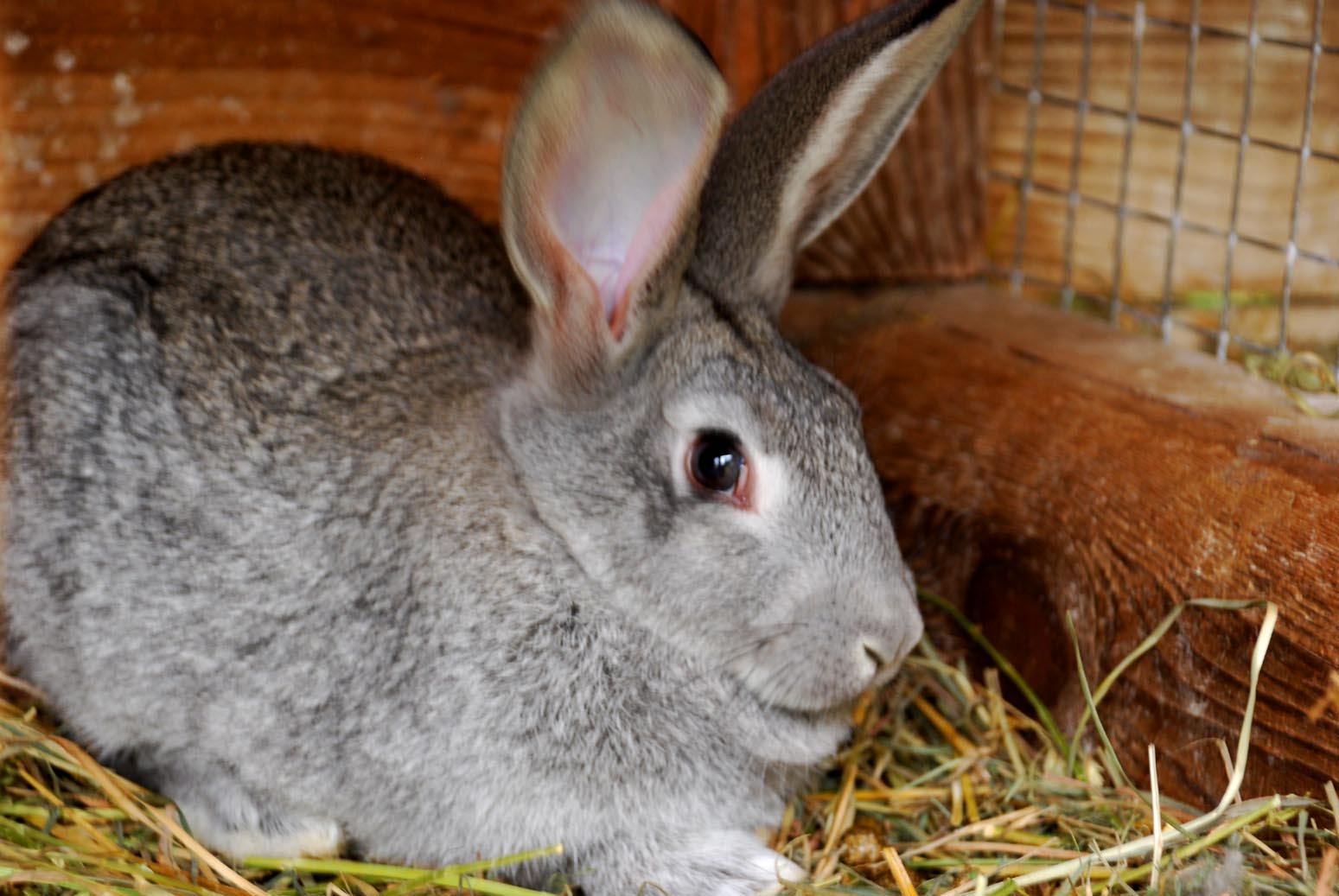
American Chinchilla's are an especially nice breed of rabbit to raise, they are one of the few breeds of rabbit that originated in the United States. Credit for developing this breed cannot be given to one breeder. Several American breeders wanted to produce a larger bodied rabbit than the Standard Chinchilla for larger pelts and more meat. Development began in the 1920’s and was originally known as the Heavyweight Chinchilla. In 1924 the breed was accepted by the ARBA and the name was changed to the American Chinchilla.

The American Chinchilla rabbits are large and hardy but  gentle. Mature bucks weigh 9 to 11 lbs and mature does weigh 10 to 12 lbs. the does are known for producing large litters, averaging 7 to 10 kits per litter. They are known for having good mothering instincts and the kits reach market weight quickly. When you first see this rabbit it appears salt and peppered colored, but when the fur is blown into 4 distinct bands of color appears. They attract a lot of attention at shows because of their large size and their fur is so soft and beautiful.
One reason I raise this breed, aside from the fact that they're beautiful and productive, is that by raising them we're helping bring back a heritage breed that is on the critical list with the American Livestock Breeds Conservancy and on the “Rare Breed Rabbits” list.  


A breeding trio I sold over the winter, 2 does and one buck, they're all so beautiful, aren't they?  Below is Zelpha and one of her albino daughters.  The first kindling Zelpha ever had last year I went out to peek in the nest box and was shocked to find an all pink kit, I was just thrilled, and ran inside to tell everyone what I found in the nest box! After researching it some more I realized that in the American Chinchilla breed if both the buck and doe that breed have the c- gene they will throw albino kits.  Now, this is not ideal for some, but for me I was excited to know we could consistently get some white rabbits for their fur. She had one albino kit her first litter, 3 the second, and 4 albino kits the 3rd kindling.  I have a buck now with the c+ gene and the two of them will not throw albino kits.  For Spring and Summer kits that I want to sell, I'll breed those two and for the Fall and Winter kits that we  mostly raise for meat and fur I'll breed her with Melvin for a few white ones.


American Chinchilla doe, Zelpha pictured above and below.


My husband is building a new set of hutches for me, now with the addition of the Cinnamon's we need more room.  We're doing an entirely different design, rather than wood that is difficult to clean and sanitize, we're building it out of galvanized metal and wire with a strong roof and removable wood panels for siding.  This is so we can pressure wash and clean thoroughly several times per year.  We're also planning to fence the entire rabbitry to keep the dogs out, and allow the rabbits a nice big exercise paddock. 


Melvin our senior buck above is a total sweetheart and loves attention, he will always give a good greeting and is a pleasure to tend to everyday, well, actually all of my rabbits bring me enjoyment, some are just more personable than others.  If you're wondering what happened to our Champagne d' Argent rabbits, I sold them all to one lady last Summer.  I decided I only needed one breed of silver and gray rabbit, rather than two breeds of the same color. The rabbits have truly been one of my favorite parts of homesteading, they're the perfect small scale permaculture farm animal.  They've provided our family with a fun hobby, along with delicious meat, luxurious furs to make things with, and the best compost for our garden.

Friday, February 28, 2014

Making a Rabbit Fur Hat

My first attempt at making a rabbit fur hat turned out pretty good, but there was a lot of trial and error that went into making it.  We raise American Chinchilla rabbits and last year I was excited to learn how to tan the exquisite furs. I used two furs to make the hat above, and I learned a few things along the way that will help me revise the next hat and make it better.  Finding a good pattern online was difficult as there's not much out there with clear cut directions, patterns and pictures.  There are several different patterns that seem to work just fine depending on what kind of hat you want to make.  I wanted a Russian Ushanka type hat with ear flaps that could be pulled down when it's real cold and tied on top when not too cold.  I'm planning to test out a couple of different patterns to see what I like best.   This is the pattern I used below, I found it on a you tube video I watched and this is the basic design they used.  Taking head measurements of circumference and height is important to get the fit just right, along with seam allowance of a quarter inch.

You need to cut out two of the head pieces and four of the ear flap side pieces, 2 of each side, plus two of the front pieces.  On my next hat it will have longer ear flaps than this pattern.  My first attempt to make a hat was made out of an old wool sweater that was accidentally shrunk in the wash, after cutting out the pattern and sewing it all up, the pieces worked and the hat fit.  I also used the same wool sweater and cut a strip about the same size as the ear flap strip and sewed it inside the lining of the hat as a head band, it helps hold the shape of the hat and is comfortable on the head,  you can also use any kind of batting for the head band. 

When I'm working on a project it usually comes up in conversation with friends, one friend while talking with my husband heard I was working on rabbit fur hats and said he and his wife had bought an old Bonis fur machine several years back and had yet to use it.  We went and picked it up and luckily there was an owners manual to study.  After many hours of cleaning, oiling, reading instructions, and breaking several needles we mostly got it figured out.  It is amazing how it works and the furs are sewn together with a very small seam.  The hardest part of the machine was the thread that it requires to use kept breaking (it may be as old as the machine and is brittle) if we put in regular thread it bent the needle.  It works perfect for several minutes and then the thread breaks, we are in the process of ordering more thread and needles from the company.   I spent many hours working on piecing together the fur and figuring out my lining.  In the end I pulled out my good old Bernina sewing machine to stitch everything together, and am still in the process of the final hand stitching.  The front head piece had to be sewn on by hand, and I'm still looking for some nice dark thin leather strap material for my ear flap tie ups.  On my second hat I'm working on I sewed the leather strap right into the ear flap while assembling.
In the basic pattern for the head piece above I will shorten the height just a little for my next hat, there was a little extra head room, and the ear flaps below need to be longer for the next one. Make sure you give yourself a quarter inch seam allowance if using a sewing machine.  Fur is an amazing medium to work with, each piece you cut out needs to be looked at on the fur side to make sure it's running the right direction so it will look good. The middle of the fur is the most durable with the edges being more delicate which is problematic when sewing because it will tear easily.  The furs should be prime, meaning the rabbit was around 6 months old (I have found 4 1/2 -5 months old is still good), and then I like to harvest in cold weather so the fur is extra plush.  Raising kits to 6 months old is a real stretch for me and my hutch space, usually they go into a movable grow out rabbit tractor.

The lining is what finishes the inside of the hat and hides all the seams, it also makes wearing the hat comfortable.  The liner is made with the same pattern for the top head piece.  For the liner I used a piece of nice quality nylon that would last a long time and not absorb moisture.  I thought about the liner and different fabrics I could use, on another hat I'm making I plan to use a nice soft cotton corduroy, you'll want to think about matching the color to the hat, for mine I went with black.  Using pins to pin everything together before you sew is the best way to make sure it all works.  Although fur as a lining against the head would be comfortable it might be too bulky, you will feel the fur around the face and the warmth of the fur is still there. 


In the photo below you can see the muskrat fur I'm working on for my next hat, it's a gorgeous warm golden color which looks better on my husband than the cooler colors of silver in the American chinchilla fur. This leads me to my next post about the rabbits we raise in our rabbitry.  We are now also raising Cinnamon rabbits so we have some warm tones in our beautiful furs.    

Saturday, February 23, 2013

Rabbit Fur Tanning

I am both surprised and amazed by my successful first attempts at rabbit fur tanning.  So far I have finished tanning 5 of the 8 furs that I have, and will work on the remaining 3 over the next few days.  The furs are turning out simply gorgeous!  I am excited because they have turned out better than I ever imagined they would.  I sure do have a whole new appreciation for the contribution of rabbits and their many benefits on the homestead.  Each rabbit produced about three and a half to four pounds of meat, we put about 27 pounds in the freezer, and now these beautiful furs!

Tanning is one part of the process, and now the fun part will be making some new things.  I want to make a hat first, then my husband wants me to make him one, we're both excited to try them out.  With one of the black furs I'm going to make a purse, and from there I'll see what is left, perhaps a pair of mittens or a scarf. 


After a week of soaking in a 5 gallon bucket of tanning solution, I pulled the furs out and washed and rinsed each one and proceeded to flesh them while sitting by the fire.  It took me about a half hour per hide and the thin layer of flesh and tissues would almost come off in one piece, with touch up around the edges.  I spent 4 hours one day and did all 8 of them, boy did my fingers hurt after that. 

The furs went back into the tanning solution for another week, then I pulled out three to start drying, a good idea is to lay them out to dry the night before you want to work them.  The furs need to dry slowly, when they're ready to start stretching and working you will see white patches, you can then begin to pull softly in different directions.  You can pull and stretch the furs carefully over the edge of a chair, over your knee or any other firm soft surface, you will begin to see how it stretches.  I had some tears occur both during the fleshing and stretching part on a few of the edges, you will notice the soft parts on the sides, the middle is thicker and stronger.  The idea is to get the hide to turn all white, as your pull it in different directions it turns white and softens. 

The rabbit fur tanning method I used is the sulfuric acid formula (battery acid is diluted sulfuric acid).  There are many sites that talk about tanning furs with this method, and I originally saw it in a book called , Raising Small Livestock, by Jerry Belanger.  Here's a great rabbit site that I found and they have written out the process to tan furs, Rise and Shine Rabbitry.    The furs turn out nice and soft with this method.  I was impressed with the size of the furs of the American Chinchilla's, they stretch and get bigger as you work them, it took about one and a half to two hours per fur to work them fully.  I worked them throughout the day at different times, I spent time to make sure each one was soft and supple.

An interesting thing that I'm experimenting with is tanning the leg part on the hide (pictured below), I left it on all the furs, thinking I may use it for the drawstring on the hat, I will turn it right side out, so it has the fur showing.  I'm not sure if I'll use it in my design, but left it on just in case it works for creating something.  I have looked at a hat design on one of my daughters hats, and will cut the pieces out to fit the size of my head, then baste it all together first to make sure the fit is just right before a final sewing.  I'm going to try and use my sewing machine for the final sewing, but may have to do some parts by hand.   
All in all it takes about two weeks of sitting in tanning solution, and a couple hours of work to tan a fur, you'll have some sore fingers, but in the end a luxurious fur to create truly one of a kind things.  It's also one more way to give honor to the remarkable rabbits that we raise, and to use every part they provide us with.  They truly are one of the best all around small livestock animals, I now know why people for hundreds of years have liked raising rabbits, they have simply loved both their meat and fur! 


Monday, February 11, 2013

Rabbit Harvest

We raise American Chinchilla and Champagne d' Argent rabbits, they are both meat and fur breeds of rabbits. It was inevitable that we would have meat and fur to harvest at some point.  Much as I'd like to just have rabbits as pets and sell their offspring for a little side money, economically speaking it only pencils if you sell them between 8-12 weeks of age, then you haven't put a lot of money into feeding them quite yet.  I went through so much rabbit food the last couple months that even I had to admit, at a certain point, it would be wiser for us to keep them in-house and enjoy the product rather than sell them.  Over the holidays I advertised them on Craigslist and sold a few, but realized it wasn't the best time to sell rabbits, the Spring, Summer, and early Fall are the best.  These two litters of rabbits were a little over 4 months old, they were not pedigreed rabbits like I will have this year.  We had a litter of purebred American Chinchilla's and a litter of half Champagne and half mini rex's.  I didn't realize the latter were not purebred until they had almost completed their growing and they didn't reach full size.   

After 2 weeks of agonizing over what to do I finally made a decision that we would do it (the night before I had a moment of madness and thought maybe I'd just let them all go free into the pasture...seriously, I thought about it) I also contemplated that if I didn't have it in me to do it, we'd just get out of rabbits all together.   But, last weekend I finally got up the courage to not feed them for the required 24 hours, then it was time...Ready or Not!  Thankfully my husband (who has as soft a heart as me with regard to animals) took the job seriously to assist me in the first part.  He used a gun for step one and a chisel and mallet for step two removing the head, and from that point on I did all the rest.   All of this was done with respect and reverence for each animal and the sacrifice they were making for us, may they be a blessing to us and may we show respect for them by using every part, including the fur.

This was not one of the  high points on this farm, but was a necessary lesson for me to know and understand the cost to feed and raise rabbits, you will have an abundance of them as a breeder.  The first one was hard on me, then I was committed and we did two batches of 4.  Once I got into the intricacy of cutting and processing them I went into a mode that is almost trance-like it is such detail work.  I saved the heart, kidneys, and liver, and of course the furs.  There was a considerable amount of meat on each one and I couldn't believe how heavy they were to lift them up and string them onto the limb for skinning.  Rabbits are considered the easiest animal on a farm to process.  I also did extensive research on curing the furs, the health and nutritional value of the meat, and what I could make with the furs once cured.  These are all different topics I will be writing more on. 

Now that I have a freezer full of delicious rabbit meat I am going to have fun trying some new recipes, the day after it all I made an absolutely delicious rabbit stew that lasted us several meals (Tessa wouldn't eat it) she has no intention of eating rabbit, but the rest of us are all thrilled to have some good fresh meat.  I baked the rabbit just like a chicken then proceeded with deboning and making the stock (boil the bones and carcass along with carrots, onions, and celery) for approximately 4 to 5 hours, this is where I included the heart, kidneys, and liver, I figured that would be a good way to get the nutrition of them into the soup.  Once I strained the stock, I added more carrots, onions, celery and potatoes from the garden.  I added the deboned meat 20 minutes before it was finished. 

The next meal I'm planning at the request of Jarin and Kaley is a rabbit pot pie.  The health benefits of rabbit are amazing, there is a high ratio of calcium and phosphorous, along with vitamins and minerals.  It is one of the highest protein meats with the lowest fat, it's easily digested and can be used just like chicken.  In many parts of the world rabbit is a gourmet meal, and served at the finest restaurants. 

The method I used to cure the furs is the sulfuric acid method.  Sulfuric acid is found in battery acid which is diluted sulfuric acid, it's easy to find and inexpensive.  It takes away some of the chore of fleshing the hides and it sounds easier than brain tanning.  I still have another week of it sitting in the tanning solution so we'll see how they turn out.  Here's a great tutorial and how I'm tanning the 8 furs that I have, Tanning rabbit furs

What will I make with the furs?  I'm planning to make myself a hat first to experiment, then I want to make mittens, a throw pillow, and maybe even a vest.  Looking online I found many cool things to make. 

The overall value of each product from a rabbit is worth raising them, from their compost to their meat and fur, as well as the ease of housing and feeding them.  They are right up there with chickens for their valuable contributions.

Wednesday, December 19, 2012

Champagne D' Argent

Hazel surprised us all over the Fall when she gave birth to four kits and won Mother-of-the-Year award for her care and nurture of them.  These were the chubbiest kits you've ever seen.  This is a picture of them at 8 weeks old with their mother Hazel. Champagne's d' Agents are an old breed of rabbit from France, they were originally called "French Silver's", there is record of them over 400 years ago.  The kit's are born all black and then gradually attain their full silver coat around 4 months old.  They are a medium sized rabbit and weigh between 9-12 lbs

 If you remember I had my frustrations with this doe not taking care of her litters.  I wasn't going to keep her, however after "The Talk" we had, she decided it was time to become a mother.  Taking time to seriously talk to my animals has brought about changes in them, and perhaps even more in me and the understanding I have for them.  I will hang onto a good animal and keep trying. 
So, I've decided to keep her and will look forward to some good litter's this next year. 

Friday, June 22, 2012

The rabbitry ~ American Chinchilla's

Zelpha "Fern"
2 month old doe, from China Moon Rabbitry

Our rabbitry is going to focus on the American Chinchilla rabbit breed.  This doe "Fern" will be with us for many years to come as our foundation doe, the first of our pedigreed American Chinchilla breeding stock.  She's tattooed in the right ear to prove it, and last week I even joined the ARBA, the American Rabbit Breeder's Association, so now Applegarth Farm is officially a registered rabbitry.

Zelpha Fern was my grandmother's name and I've always loved it!  Mostly because it represented my grandmother and she was an amazing woman with so much energy and zest for life.  I remember her cooking and love of family and wanted to think of her often.  The story behind the name is that her mother, my great grandmother made up the name with a friend when they were 10 years old and were talking and playing and thinking about names for their future children.  My great grandmother chimed out saying, "I'm going to name my firstborn daughter Zelpha Fern", and she did!  I remember my grandmother telling my sister and I the story when we were about 10 years old, she had a real southern Oklahoma accent with inflection and tone that made stories fun to listen to. 

Of course I had to name her husband, the buck Melvin.  My grandfather's name is Lawrence Melvin "Mel" for short.  My grandpa is still alive and still gardening.  I'm sure he'll hear about me naming my rabbits Mel and Fern after both of them.  As I say their names to my new rabbits, I often think of the many happy memories our families have shared over the years with both of my grandparents.
American Chinchilla buck Melvin "Mel"
from the Tree House Rabbitry


Serendipity
One year old American Chinchilla doe 
bred to Tobin of China Moon rabbitry on 6/8

Serendipity, our one year old American Chinchilla doe came with us as we travelled South on I-5 for an hour and a half as we headed to China Moon Rabbitry.  She was coming with us to be bred to one of their nice pedigreed bucks named Tobin, I hope to get a picture up soon of him. Melvin is from a totally different rabbitry in the same area called The Treehouse Homestead rabbitry.  He's a 3 month old buck that is non related to both Fern and Serendipity.  We had a nice time at China Moon meeting Theresa the breeder, and I had fun seeing all of her rabbits and her whole set up.  It's nice to talk to other's who are further along in their breeding program, I always learn new things by asking questions.  Thank you Theresa for the rabbits and the breeding to Tobin, we enjoyed our time at their rabbitry, talking with both her and her husband. 


Fern is happily rooming together with Serendipity for the next few weeks, and a few days before she gives birth, Serendipity will get her own large cage as we're growing more cages are being built along with the rabbit tractor.  Melvin is in the cage next door, and next to him are the Champagne d' Argents.

Monday, March 5, 2012

kindling on a cold blustery night


Last night, right before bed I went outside to check on Serendipity our American Chinchilla rabbit, I knew she would most likely be kindling that night.  I had given her a nest box 3 days before and helped her line it with soft hay, plus I gave her plenty of extra to work with for nest building.  She's a first time mother, so I wasn't sure if she would know what to do.  Yesterday I began to wonder why she hadn't pulled any fur to line the nest box, I checked her throughout the day. 

First thing this morning I ran outside through the wind and rain to check on her, sure enough she had given birth to 6 kits.  But not in the nest box, and she had pulled very little fur, they were all chilled to the bone, and she was sitting on one that had already died of exposure.  I gathered them all up as quickly as I could and raced inside.  Once inside I ran and grabbed two hats, doubled them up and put all the babies inside, warming them by the fire.  I also filled a small bowl with very warm water, and submerged each one up to the neck to get warmth into them, and then softly rubbed the squeaking babies dry right beside the fire.  It took my daughter Kaley and I an hour to fully warm them.  In the end two of them had died before we brought them in, and four are all healthy and warm now, they're still all snug and sleeping soundly in the hat until I make them a special place for a nest.

I've been doing hourly checks on our Champagne d'Argent doe Hazel, due today or tomorrow.  I don't want to lose any of her kits to exposure or the cold.  She's also a new mother and doesn't appear to have good nest making skills,  this is my first time breeding these larger rabbits, so we're on a learning curve I'm sure.  The mini rex's that we've raised for years were the best little nest makers ever, they'd spend several days working on their nests and would pull huge amounts of fur to give their babies a soft, warm nest. 

For now I'm going to set up a nursery inside the house and bring the mother in for feedings, we'll put them outside when they have fur and it warms up a bit in a few weeks.  I may have to do the same for the other rabbit if her mothering instincts don't kick into gear soon.  It's always easier for the newborn animals when it's warmer, or at least isn't so cold and windy.  For now I'll be running out to check on Hazel throughout the day and may just bring her inside to give birth.

Have any of you had this happen with your rabbits?  I'm not sure what the right thing to do is, maybe I should pull fur from the mother rabbit and make a nest and put them back outside with her.  For now, I just want them to stay warm and alive close by where I can check on them regularly.

Tuesday morning update, after keeping the kits by the warmth of the fire in the house for 7 hours, they woke up hungry!  I had been watching the mother rabbit and can you believe this, she pulled her fur and made a nest after the fact, and seemed to be looking for her newborns.
After much thought, I decided to take them back out to her in the hat I donated to them, I rolled the sides down so they could stay inside their cozy spot.  Once back in their cage, I put them in her nest and put fur over them.  The mom jumped in the box several times, sniffed them, and then I watched her begin to nurse them!! just like that, it made me so happy!  In this instance letting nature take it's course worked out.    I checked on them several times throughout the night, since I'm on watch for the other new mom anyways.  Everyone is doing good!

Thursday, February 23, 2012

Champagne d'Argent and American Chinchilla rabbits

Champagne d'Argent doe ~ "Hazel"
After researching rabbit breeds that are good for meat, fur, and selling offspring as breeding stock, I found the Champagne d'Argents and the American Chinchilla's were the 2 breeds I wanted to try.  Last summer I started with 2 does and a buck, they've really grown over the Fall and Winter.  Come the first of March we should have both does kindling.  I put Serendipity our American Chinchilla doe in with Filbert, our Champagne d'Argent buck on February 2nd.  And I put Hazel, our Champagne d'Argent doe in with him the very next day.  Rabbits are pregnant for about 30-31 days, and it's called kindling when they give birth. The Champagne d'Argents are pedigreed so we'll keep one doe and sell the remainder as breeding stock. 
Champagne d'Argent buck ~ "Filbert"
The American Chinchilla doe is not pedigreed, but is still a gorgeous specimen of the American Chinchilla breed.  If we can't sell the bucks we'll raise them for meat, the rabbits are harder for me than chickens, I hope we can sell all of them to families wanting these heirloom breeds.  This is kind of an experiment, and I'll keep you posted here with the results.  Last summer I did buy a Chinchilla buck for the American Chinchilla doe to breed her to.  We still have him in the cage next to hers, but he turned into the smaller Standard Chinchilla.  The person I bought him from had been given a litter and wasn't sure which kind of Chinchilla he was.  The one's I have are the larger version of the Chinchilla.   I didn't breed her to him because of his size. 

American Chinchilla doe ~ Serendipity
The first breeding for Serendipity I decided to breed her to Filbert, and I will be looking for an American Chinchilla buck this Spring for future breedings.  I found a farm about an hour away that raises pedigreed American Chinchilla's, so will most likely buy a buck and doe from them.  Why do I like pedigreed rabbits?  Well, because as a small farm industry I want to sell quality pedigreed breeding stock, simply because they're worth more.  .  I'm planning for 3 litter's per year, and they usually have around 5-7 kits per litter.  They need to be with their mother for a minimum of 8 weeks, and doelings can be in with her longer. 
Hazel

The rabbit part of our farm is so enjoyable for me, rabbits are sweet and personable, they're small and don't eat too much, although mine are fed really well.  They produce large amounts of wonderful compost material and are easy to house.  Rabbits were the first farm animal we got here at Applegarth, and we all fell in love with them.  Plus rabbits are a great way to start out small and begin your backyard permaculture plan.  My dream is to have a rabbit tractor this Spring and I want to work on a pasture just for them so they can get exercise, dig in the dirt, and lay in the sun.  All animals in my care get the opportunity to run free at certain times, they get to stretch their legs, eat grass and lay in the sun.  Over the last 5 years I've brought many rabbits out to the garden to play in the sun while I work.  It always brings a smile to heart to see them so happy, running and leaping and playing, the garden is totally fenced in so they're safe.

Right now I have 4 mini rex's in the chicken aviary, they have lived there since last summer when I brought the new rabbits in.  They happily got bumped from their cages and I think they're really enjoying being free, running and digging, they've made an extensive rabbit warren underground, and they live in total harmony with the chickens.  In the evening they come running to me when I call them because they know the chickens are in bed for the night and they get their own special food, a partial flake of grass hay or alfalfa, some rabbit pellets, and their favorite cracked corn.   From about 5pm until daybreak they have the total run of the place until the chickens wake up.  Everyone seems happy about the arrangement.

 As rabbit breeders we will inevitably have rabbit on the menu.  Rabbit meat is delicious, in France and throughout Europe it's very popular.  I had never eaten rabbit meat until last year when we had 5 bucks going into the Fall that we couldn't sell, and we didn't have cage space for them.  So my son brought them to me all processed and I made rabbit stew and rabbit pot pie at his request.  Rabbit meat is a good protein that can be raised economically and humanely in a small space.  If you're at all worried about where your meat comes from you may want to look into rabbits.   We don't plan to eat a lot of rabbit, if we had it a couple times per month that would be enough.  
American Chinchilla fur

This brings us to the fur, what will I do with the fur?  My son cured the pelts of the 5 rabbits he did last year.  He studied the information in several books and spent time on each fur.  This Fall I'm sure I'll  be learning myself how to cure the exquisite hides.  What will I make with them?  I don't know yet, perhaps a hat, or a cozy throw if I save up enough.  This is something I am going to have to research more.

Monday, September 26, 2011

meet the new rabbits

Meet our newest Champagne d' argent buck, his name is Filbert (in light of a Filbert tree I planted in front of the rabbit cages several years ago).  Can you tell how curious he is?  I had no idea that a rabbit could be so friendly and funny, he runs to the entrance when I open his cage, and says hi, he loves to be pet and talked to, he likes fresh sticks to chew, and loves alfalfa and dry cob (corn, oats and barley).  He is 13 weeks old,  pedigreed, and will be a fine breeding buck here at Applegarth.  In the picture below you can see he still hasn't gotten all his silvering that comes with maturity.  When Champagne d' argents are born, they're all black, they turn silver as they age.

Pictured below is our newest rabbit, an 11 week old American Chinchilla doe.  She's roomed next door to Filbert and they seem to like each other.
Here's a little history on the breed.
The American Chinchilla rabbit was created in the 1920s using Standard Chinchilla rabbits and breeding them for larger size. This was to create a rabbit with a larger pelt and bigger body for meat.  It was one of the more highly paid for pelts at the height of the fur industry.

Originally, it was known as the American Heavyweight Chinchilla, it is one of the few rabbits that is truly unique to the United States. Now it is one of the Rare Breed Rabbits, seriously threatened with extinction. The American Livestock Breeds Conservancy has listed this breeds' condition as Critical, and they are encouraging more people to raise this fine breed of  rabbit as a heritage animal.

This is my first American Chinchilla rabbit, she is unbelievably soft, her fur is exquisite, plus she's a real sweetheart, and loves attention.  These are the two breeds I'm going to focus on, the Chamgagne d' argents and the American Chinchilla's.

Monday, June 13, 2011

Champagne d'Argent doe

Our newest addition to Applegarth Farm is this beautiful Champagne d'Argent doe, she's almost 3 months old, and already weighs about 5 pounds.  She'll top out at around 9-11 pounds at full adult weight.  We picked her up today from a breeder I met on craigslist several months ago when I began my research of this heritage breed.  I have also reserved a non related buck that will be due in a month.

This doe represents some big changes in our rabbitry, we will be selling most of our mini rex herd of 3 does and 1 buck, along with the 9 babies.  I talked with the feed store today, and they said they'd take all 9 babies, but no adults.  I also showed them our newest rabbit and shared with them my rabbitry changes.  I wanted to talk to them because we had been supplying the feed store with several litters of baby mini rex bunnies every summer for the last few years.

This purebred doe is registered with the ARBA - American Rabbit Breeders Association, and has an ear tatoo, B-21, and official pedigree. The seller said she hadn't been handled much, but she sure was good all day since we picked her up, I think she likes her new room mates and the view of the upper meadow from the rabbit hutch.  One thing we all noticed about her is that her fur is exquisite, it's soft and smooth, darker underneath, and almost white on the tips, it's just gorgeous, and is hard to tell how nice it truly is through just a picture.

Today was a rabbit day for me, when we got home and I set her all up in her new cage, gave her fresh food and water, and let her settle down.  Moving day is stressful whether animal or human.
 
I spent time grooming the other 5 rabbits we have, clipping toenails, and brushing  our Angora Peppermint.  Her fur is getting so long, I brushed her for a long time, she just loved all the attention.  It's important when you have rabbits to feed them quality food, fresh greens, and fresh water daily.  One thing you also need to do is trim toenails every couple months.

Why am I changing my rabbitry from pet rabbits to meat and fur rabbits?  In times of prosperity rabbits are for pets, in times of economic challenges rabbits are for meat.  This is historically speaking of course, but my plan is to get 3 does and 1 buck, and breed them like I have been with the Mini Rex's and will eventually be sellling breeding pairs, a buck and doe will sell for $90/pair.  With the Mini Rex's the most we were making was $10/rabbit.  These are bigger rabbits so they produce bigger litters. I'm planning for them to get mature enough, and will breed them the end of next Jan for babies next March, I surely don't want one of my rabbits having babies in the middle of winter, that would not be a good idea.   

Champagne d'Argents are meat and fur rabbits.  I do plan to have some rabbit on our menu several times per year, not in the near future, but when I have so many rabbits and want to sell and keep the best, then there will  be some.

Friday, May 6, 2011

the rabbitry

Future plans for the rabbitry are to phase out of Mini Rex's and buy a breeding pair of Silver Fox rabbits, and a breeding pair of Champagne D'argent rabbits.  I've been in contact with a breeder close by, and also placed a wanted ad for both breeds on Craigslist.  I'll be waiting to sell my 2 pregnant Mini Rex does until their babies are 8 or 9 weeks old.  Currently I have a 1 year old doe and 2 year old buck for sale. 

Silver Fox rabbits weigh around 9-12 lbs. Their fur is unique as it's longer and courser than other rabbits, they're named after the silver fox because of the similarity in their coats.  This is a breed that was near extinction not too long ago, and are still on the road to recovery as a heritage breed.

 This is a Champagne D'argent rabbit, a breed that is over 400 years old, 
they're from the Champagne region of France.

It's been a lot of fun raising Mini Rex rabbits, however with changing times and the economy come more practicality.  The old saying, When time's are good rabbits are for pets, when times are lean rabbits are for meat.  Thus my decision to totally change my breed of rabbit from a pet breed to a meat breed.  Silver Fox and Champagne D'argent's are meat and fur rabbits.  My plan is to raise them not only for our own meat, but to also focus on selling breeding pairs.  A good quality purebred breeding pair is approximately $80, or $40 each for bucks or does.  I will  hopefully be going to look at a Silver Fox buck this week to check out more about this breed.

I've researched many of the meat breeds of rabbits, and have looked into California's, New Zealand's, American's, Dutch and Florida rabbits.  I keep coming back to these old breeds of rabbits.  I like the idea of raising heritage breeds too.  My thinking is that more people may be buying meat rabbits in the days ahead rather than pet rabbits.  The kids have been in charge of the rabbitry over the last 4 years yet I have been taking care of them more as they've gotten older and are more involved with friends and sports.  The Mini Rex's were great for all those years, and kept the kids in spending money throughout the late Spring and Summer months.  For any parents with small kids that want sweet small rabbits, I would highly recommend Mini Rex's.

We also have an Angora rabbit named Peppermint, who we just clipped a couple of days ago, we will be selling her as well, when her fur grows back thick in a couple months.  The main reason for selling her is cage space.  Then I'll have access to 4 large cages to house the other 2 breeds.  We're also planning to make a chicken/rabbit tractor, that I will rotate with each other on different days so they can all have access to fresh grass and greens.

A note about feeding rabbits.  This is what I feed: rabbit pellets, alfalfa, corn or scratch grains ( a small amount of whatever I'm giving the chickens) alfalfa every other day, grass, clover and dandelion greens are the most important part everyday.  It only takes a few minutes to gather for them and they love it.  They will always eat this before anything else, otherwise if I don't add fresh greens the next priority they'll eat are the corn.  I also make sure I always have a salt and mineral lick for them.  They get kitchen and garden treats like apple and carrot peelings, lettuce, and other vegetable ends.  I like to give them a variety of things and usually rotate days with corn and alfalfa.  The rabbit pellets form the base and everything else fills in the nutritional needs.  Fresh water everyday is critical, and needs to be checked twice a day. 

I feed all the animals in the morning, so the rabbits are in the feeding routine, they like it and can count on me seeing them and feeding them every morning.  You know I'm really looking forward to a change in our rabbitry, and will have fun getting it all set up and running.  I'd like to double my cage space, and create a pasture area surrounding the bunny barn, so they can have a yard to run around in. 

Part of the plan for our farm is to make sure every animal has a purpose and can pay for their own feed.  While this is not possible in the beginning stages of getting set up with your breeding stock, there comes a point where you want each group of animals to be self sustaining.  I want to keep a ledger and better track of all my farm receipts, to know how much it costs for the chickens, rabbits and honey bees, and soon to be goats. 

Do you have a favorite breed of rabbit or know of another meat breed of rabbit that I haven't mentioned?  What do you feed your rabbits?.

Saturday, March 5, 2011

10 day old bunnies

The baby Mini Rex bunnies are growing fast,
their eyes will be opening over the next couple of days. 

Wednesday, February 23, 2011

rabbit babies ~ just born today

We had 2 of our Mini Rex does give birth (kindling) last night and today, during one of our worst winter storms, it's been snowing for 2 days, and is around 25 degrees.  As you can see they are all snuggled into a warm nest of downy fur.  The mother rabbit pulls fur from her chest and sides to line the nest, and covers them, so they're all snug.  I pulled it the fur back to take this picture, then covered them quickly to keep in the warmth, there's another one in this litter tucked in underneath these three.  One of the rabbits had 4 kits, and the other one had 3 kits.

When rabbit kits are born, they are almost bald, with their eyes closed, their fur will grow quickly though, and before too long their flat ears will begin to prick up.  I'll take pictures once a week so you can see how cute they are, and how fast they grow.  Our rabbits have been some of the most enjoyable of our farm animals, we've had several that have became so tame, they would run up to us and sit in our laps to be pet. 
Today I gave the mothers special treats of apple peelings this morning, and leftovers from our dinner salad, we always give special treats to pregnant does, and extra special goodies to new mothers, especially while they're nursing.  I also brought both does inside for a nail trim and file, this needs to be done, so when they crawl in the nest box to feed they don't poke them with a sharp toe nail.  Usually we don't pick them up for several days, so they can bond with their mother.  I did reach out and gently pick up this one for the picture, the mom knows me and trusts me.   We'll probably keep a couple of these rabbits, and will sell the rest to our local feed store for pets, they've been buying them from us now for the last 2 years, and always sell out quickly.