Showing posts with label Farm Life. Show all posts

Monday, March 17, 2014

Spring Goat Kids


Our little Nigerian Dwarf dairy goat Snowdrop had beautiful triplets one week ago.  The next day was sunny and 60 degrees, so in the afternoon I brought them all outside for about 15 minutes to enjoy the sun, meet the other goats and take a few pic's, then I hurried them all back into their cozy nest in the barn.  Snowdrop had twin doelings pictured above, and all three kids pictured below with the dark handsome buck on the left, we may keep him for the Fall breeding season.  I love all of the colors and markings each kid this year. 


Our Nubian Jersey and I were up all night this past Thursday night as she delivered twin doelings pictured below, they are melt your heart cute, and are miniature replica's of Jersey. She was bred to a Nigerian, so these are miniature Nubians.  We are lucky this year to have 4 doelings so far, now just our Lamancha Zolena is left and she's due this Friday, I hope she has at least one doeling too.


    We've been loving all the Spring babies and new life everywhere we look! 

Wednesday, April 4, 2012

Early Spring around the farm


It could be true... we think Jersey might be pregnant.  I've been feeling her belly everyday, and it feels like she has a couple kids growing inside of her.  I hope it's true, we'll all be watching.  This would most likely mean she got pregnant on the first breeding in mid January and will then be due around the middle of June, I'm crossing my fingers and hoping.  Can a goat go into heat every 3 weeks even though she's pregnant, could it have been a false heat?  


Yep, she looks pregnant to me!

Cowboy likes to hang out with everyone and chat.
Serendipity and one of her 3 kits, they're all doing well.

Joon might have twins or triplets, she's getting bigger by the day and is due around the first of May.  Cowboy is the father, they're both Nigerian Dwarfs, along with Stormy and Snowdrop.

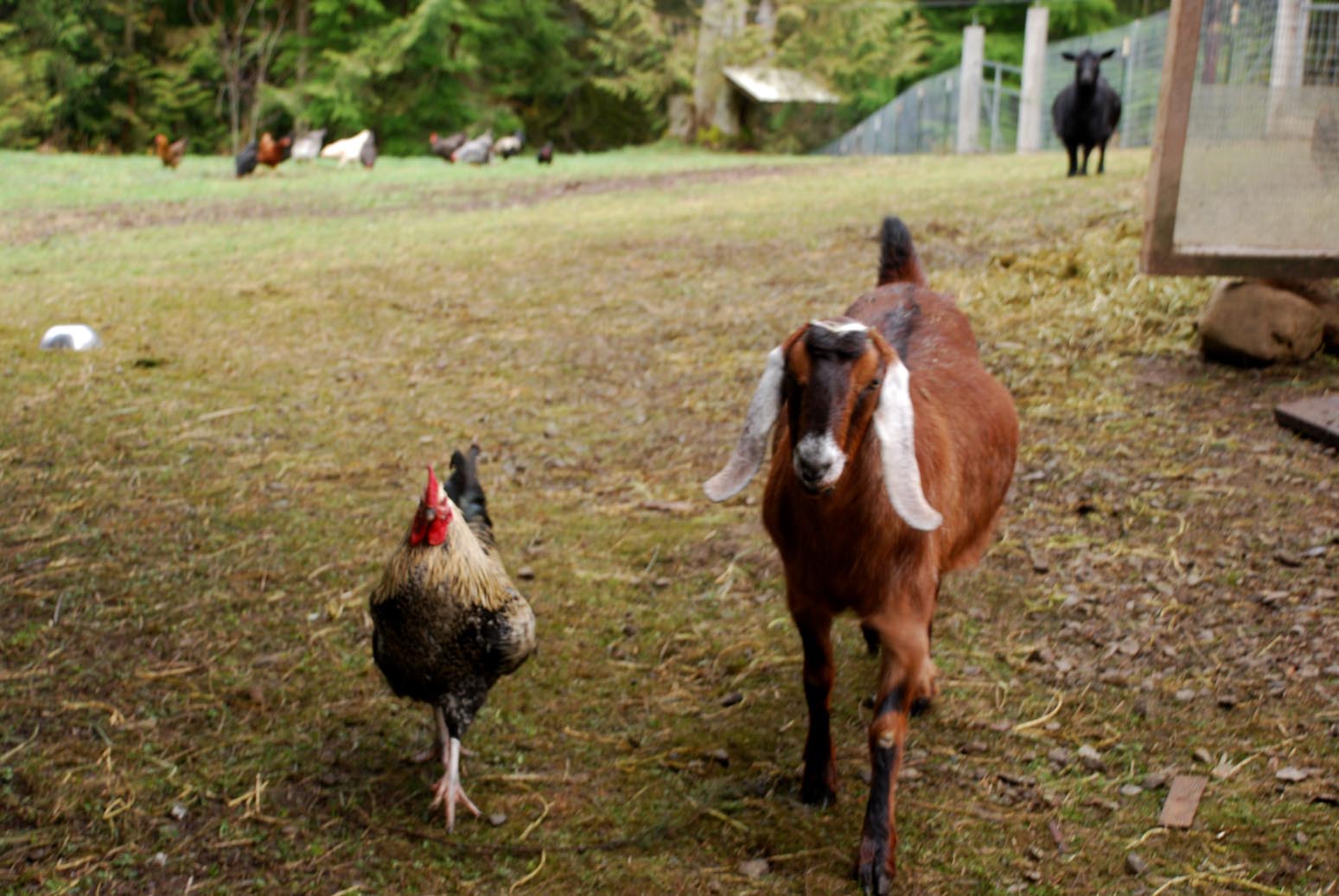
This is the mystery chicken that we got as a freebie when we bought the batch of cornish cross meat chickens from McMurray hatchery.  We raised him right along with them and then put him in with the laying flock, we were'nt sure if we'd get a hen or a rooster.  Well he's turned into the most friendly rooster ever, he tags right along with me everywhere.  He's the one walking towards me in the first picture with Jersey, and the one with Joon and Snowdrop.  Right now he's just getting to hang out with the flock, but my plan is to post him on Craigslist for sale.  He looks almost identical to my other farm yard rooster, but he's from McMurray Hatchery so must be a purebred.  Someone may want to add a friendly rooster to their flock of hens I'm hoping.

The new pasture is connected to both the goat and chicken barn, you can see the grass is really starting to grow.  The chickens and rabbits also have their own fully fenced aviary that they still go in often, it has an opening that is small enough just for them to pass through and not the goats.  It's a totally safe zone, however most of the time the rabbits run all over.  We opened up the new pasture and it's been three weeks, so far so good, I was worried about air attacks from hawks or owls.  All the animals are living in total harmony, when everyone has free browse and plenty of food and water, they're all happy.  One important goal we have is for us to eat well, including the animals, everyone in my care is well fed and has fresh food.

Hazel and Filbert saying hi to each other during feeding time. 
Hazel has been building her nest, she's due anyday.

Blooms on the young hazelnut tree in front of the rabbitry.

Sunday, February 26, 2012

snowy weekend


Josie and Summer watching the goats beside me.

They all take off running through the snow.

 "You never know they might come back."

 "And we all know... Zolena will get us with head butts, just to let us know who's boss around here." 
The puppies have grown up with the goats and know them well enough to give them some respect.  They also know that Zolena just plays with them and gives them mock head butts, that's why Josie doesn't look too scared.

This is our sweet and funny Zolena, always clowning around with us and the other animals.  She's a Lamancha dairy goat and is our main milker this winter.


Everyone likes to watch Dad building things.  Over the weekend he worked on
a goat fencing project all through the snowy days.  He had lots of company.

A newly installed gate, and fresh concrete posts he made a couple of weeks ago.  

Stormy and Zolena love to play the game of head butt. 
You can see Joon in the distance, she's pregnant and is about halfway through her 5 month pregnancy.

"Enough running around in the snow we're ready to eat and lounge for awhile in our goat cave."  The basement of the chicken coop is the goat barn for our first winter until the new barn is built this summer.  The chickens have the second story, and the goats the lower level, they're totally separate quarters.  The goats all love their cozy little barn, it's on the short side, but once inside it's about a foot above the taller goats heads, it's warm and dry, and they all seem to like it just fine, this is where they sleep, ruminate, and hang out.  

Tuesday, November 22, 2011

First Snow


We had our first snow a few days ago, it was about half an inch, and the goats and puppies sure had fun playing in it.   Frozen water buckets and rabbit bottles were extra work, along with hauling hot water out to the goats and chickens and thawing frozen hoses.  Fortunately the snow didn't affect the roads into town.   You can see in the picture above that we have our herd of 5 goats going into winter.  Snowdrop is the newest goat we have, she's a little 4 month old white Nigerian Dwarf doeling, she came here about a month ago.  The goats have added both fun and work into our lives, along with milk, and lots of wonderful compost material.  We are working on fencing and I spent the day cleaning out their goat barn and filled it with fresh dry straw.  I've also spent time everyday studying the goats and watching for signs of being in heat. I have a record for both Zolena and Joon and their last dates in heat, and am waiting for Jersey to come back into heat, somehow I must have missed her last one.  We've already tried to have Joon bred once, but I think our timing was off by a day. 
The puppies are growing so fast, they're 6 weeks old now.  This morning they all followed me out to milk right along with their Mom.  Summer loves the routine with all the farm animals, and  goes with me whenever I head out to the barn, now I can tell the puppies will love going out with us too.  They were fascinated to watch the chickens and goats, Zolena just carefully stepped around them and jumped onto the milking stand.  Goats and dogs once they get to know each other, get along quite well. 
 This is Rhododendron  Ridge Sparkling "Snowdrop",  her father is Pecan Hollow Bronze Snapdragon, and mom is Calico Creek Meadow Bluebell.  Her mom Bluebell has a gorgeous udder, and her father has good udder genetics as well.  Snowdrop was the first goat I put money down on over the summer, she wasn't even born, and I went to see her mother, and put a deposit on a doeling, not even knowing if she'd have one.  We had to wait for her to be born, then wait 3 months until she was old enough to come here to Applegarth.  We have all just fallen in love with her, and her sweet personality, and so have the goats.
Exploring and playing, Josie happy and smiling.
Stormy, Jersey, and Snowdrop all munching on some douglas fir greens.  We took down several trees last week for the fence line and the goats love to eat the tips of them.  The goats are interesting to watch all the things they eat, moss on trees, various ferns, dried leaves (chips),  bark, and of course any edible berry bush.  They are more deer like and will leave the grass as a last resort. 

Wednesday, October 5, 2011

Early Fall

Everyone is off to work and school and I'm home all day, Yeah! I love being home! 

Fall is here in the Northwest, and the rain has begun again.  I'm sitting here writing and procrastinating on the morning milking, waiting for a little reprieve from the downpour.  The milk stand is under the eaves of the goat and chicken barn and we all get wet during rain.  A priority before the heavy Fall rains will be a cover for my milking area.  Early this morning I fed everyone, so now we're all just sitting under cover watching it come down.

The rain also gets me to thinking about my pickling cucumbers in the garden,  I need to harvest them and will make crock pickles with the large ones, and jars of pickles in vinegar and herbs with the smaller ones.  The basil is not liking this rain either, I need to go pick it right away, and make pesto.  *Note to self, pick basil before the end of September next year.

There are apples, plums, and asian pears hanging on the trees, we've been eating from them everyday, and will be harvesting them over the next couple of weeks.  This year our bumper crop will be plums, we have 4 mature blue gage trees that have hundreds of plums per tree, about every 3 or 4 years these trees decide to give a haul.  I'll be making plum preserves, dried plums. and plum juice. 

In the garden I still have potatoes, carrots and beets to dig, and am hoping the delicata squash will ripen before the first frost, I'll leave them on until the end of the month.  I also have tomatillos to harvest, we've never had to plant them, they just come up year after year, and we make the most delicious salsa verde with them. 

Fall brings the sounds of the Douglas Squirrels dropping fir cones everywhere, these industrious little guys scurry up and down the trunks of the large Douglas Fir trees in the forests, you can hear the cones drop and watch them race through the tree tops. Watch out if you walk under a tree where they are, they have a good aim, and must have fun with their cone bombs trying to hit us.  Fall is also the smell of the Katsura trees, the smell is undescribable, cotton candy-like, it comes when the leaves turn yellow and fall.  Vine maples are beginning to turn red, orange, and yellow, and the sedum autumn joy and purple cone flowers are still blooming.

This morning I got a fresh batch of sourdough started, my old batch I had left too long and it went bad, this can happen if you don't watch it close enough. Possibly it failed because I didn't have it stored in the refrigerator, which helps slow it down and last longer.  I decided to experiment  this time and try the yogurt maker to start it in.  The consistent warmth might help speed up the process of making a good strong sourdough in less time than the typical 2 weeks, which is about how long I have found it takes to get a really good flavor.  You can begin to use a starter after 3 days, but it's much better to let it work a little longer.  I'm hoping this will speed up that time.  The main thing I'll do is check on it regularly, and  feed it when it get's thin or too sour. 

To make the sourdough, I use fresh dark rye flour (Bob's Red Mill), mix a little warm water into it and make it a little thicker than cake batter. I start with about 3/4 of a cup of flour, it needs warmth to get going, so usually I just set it in a jar by the wood stove, and add flour every day or two.  You know it needs to be fed (flour added) because it will bubble and then fizzle out, then you need to feed it with flour, if it gets too full you will need to take some out, also allow half the room in the jar for expansion.  I only use the rye flour to get it going and feed it for a couple days, then I switch to whole wheat flour.  This Fall I'm looking forward to baking with my sourdough, we love pancakes, bread, and muffins made from it. 

On the stove I have pheasant stock going.  How in the world did I get a pheasant?  Well, A couple days ago J came and told how a pheasant had flown under his truck while on the way home, it was on our hill so not a lot of traffic.  He knew the tires didn't run over it, but when he looked back it was dying.  He felt really bad and went back to look, it was almost dead and must  have tried to fly up as it went under the truck.  A lady went by in a car and said "Oh how sad for that beautiful bird" he felt the same, picked it up by the feet to bring home, and as he was walking back to the truck another car came by, this time with a guy, he gave the thumbs up sign and said "Good for you!" 

While we all felt bad about this most beautiful bird dying, we gave it honor by saving some of  it's gorgeous feathers for craft projects, we had a wonderful meal, and now I'm making soup.  The girls and I had never eaten pheasant before, and let me tell you, it was so good!  I stuffed it with cooked rice, fresh sage and garlic.  I baked it and as a side dish we had steamed kale from the garden.  Yum, here's to Fall, the harvest and good eating, and thanks for the many small blessings that come our way.  Well the rain has slowed, I'm off to go milk. 


Thursday, September 29, 2011

6am call

I got up this morning a little before 6am and started a fire.   As soon as I was done the phone rang, it was the Post Office saying my package of chicks had come in.  I said, "I'll be right there!"  I got the kids up, made a quick cup of tea to go, and jumped in the car.  It takes me a little less than 20 minutes to get down our hill, through the valley, and into town.  I made it back in time for us to have a peek inside the box, then I ran the older kids to the bus stop.

10 days ago, I ordered 25 jumbo Cornish cross chicks from McMurray hatchery.  We've never ordered chicks through the mail, so this was a fun new experience.  In my order they also included an extra freebie, "a special rare chicken".  We'll let it grow and feather out, then it will join the laying flock,  and wait to see what kind of surprise chicken we got.  They also included 3 extra chicks, possibly in case a few died in transport.  Well, I'm happy to say they're all alive and thriving.
Kaley is the next to wake up, I take her to the bus stop an hour later at 8am.  Here she is holding one of the babies as we all sit by the warm fire.  We know these are meat birds, I told her that they're really only bred to grow and get big for a certain amount of time, like 8-10 weeks.   This will be our first batch of chickens that we are specifically raising for meat, 28 chickens will be ready right around Thanksgiving time.   I will raise them with the best life I can give them, and as we sustain them now, they will sustain us.  I am going to love going into winter with a freezer full of the best homegrown chicken. 
You can see my surprise chicken is the only black one in the bunch.

Monday, September 26, 2011

Fall bounty ~ Gathering Hazelnuts and Filberts

Hazelnut trees can be found all over our Northwest woodlands and the hedgerows of older farms, they are our native species of nut.  Through  the centuries these nuts have supplied so much more than just food for settlers and natives. They have long been associated with wisdom, even magic, and everything from witches' wands, to royal sceptres and water dowsing rods were made from their precious and pliable wood.
The common wild hazel grows in abundance all over the Northwest, and seeking out its nuts is one of the easiest foraging jobs, (alongside blackberrying, which you can often do at the same time). Fresh, green hazelnuts are crisp, and slightly sweet, an utter delight when compared to the dried store bought ones.

Right now is the time to harvest as the nuts are falling from the trees, you will have to be quick to beat the squirrels.  When you know what a hazelnut tree looks like, you will see them everywhere.  Last week I went hazelnut and filbert picking next to where I work, these are the pictures of the trees I picked from and the nuts once I shelled them.  
I don't know how old these trees are, but they're probably around 50 years old, they bear loads of nuts that were dropping everywhere as I picked them off the ground.  When you stand below an old hazelnut tree, you feel small as they tower overhead, cathedral-like in their magnificence.

Below is a picture of what the nuts look like growing on a branch.

Pictured are both filberts, the longer pecan looking ones,
and hazelnuts the traditional round cobby ones.

If you don't have time to gather your own hazelnuts at this time of year, you will find them in farmers' markets where they sell commercially cultivated nuts. They're bigger than wild hazelnuts, but just as delicious when very fresh, check the frilly casing that it's not too dried out.
Along with hazelnuts, there are also filberts, the difference between the two is that hazelnuts are round with short, frilly husks that expose the end of the nut, while filberts are longer, thinner and covered by their husks – their name comes from St Philbert's Day on August 22nd, the date when hazelnuts are supposed to start ripening. .
Once you've eaten your fill of fresh hazelnuts, dry any you have left over. Store in a dry, airy room or shed in shallow layers in slatted boxes, or hang them up in mesh bags. Turn them regularly, or give the bag a shake, to ensure they're drying evenly and, once dry, remove the husks and store in a cool, dry place. And then you'll have hazelnuts!
Dried hazelnuts and filberts are a great addition to all kinds of dishes – toasting brings out their yummy flavours. Whole or chopped, they add crunch to autumn salads and stuffing's; ground, they're very good in biscuits and cakes, particularly when paired with chocolate.  I definitely have squirrel-like tendencies this time of year as I harvest and stash in preparation for winter's cold. 

Friday, August 5, 2011

milking goats

Kaley loves to help me with the goats, she milks Joon our little Nigerian Dwarf, and I milk Zolena our Lamancha.  New routines have been established since the goats arrived, feeding, milking and tending to them takes time in the morning and evening.   Sometimes it means milking a little earlier or later than my ideal 7am, and 7pm milking times.  Goats like routine, with regular feeding and milking schedules, it takes me 45 minutes to an hour in the morning and evening to milk and feed everyone. 
I am so  thankful for the goats, and am happy every time I get to milk them, it has been a dream of mine for many years to have dairy goats.  Finally, I'm at a stage in my life where I can truly appreciate all the home made dairy products and their value and nutrition for our family.  Now, in the early mornings and evenings as I walk across our field toward their barn and paddock area and hear them calling to me, it takes me back in time, to a farm wife, and a part time dairy maid, where there were few cares in the world other than the closest people and animals of home.  I feel like I'm right where I'm supposed to be in life. 
 Zolena is our main milker, she's a Lamancha dairy goat and she gives almost a gallon of milk per day. Plus she's super sweet, and lucky for me the milk stand and all her milk supplies came with her. 
The first day my Lamancha doe came here, I christened her new name to be Zolena, she was called Ace.  I didn't want to call her Ace, so named her from a character in the Jean Auel Mother Earth Series, the head Zelandonii's name was Zolena, she represented the Earth Mother.  So in the end after much thinking about different names, the original name Zolena it is.

I have 3 stainless steel buckets and a strainer I carry out to the milking, along with a towel and tupperware full of hot sanitary water.  The biggest bucket has ice water in the bottom third, the second smaller bucket sits inside the biggest bucket, and the strainer sits on top.  I milk into the smallest bucket and pour 5 or 6 times throughout milking in through the strainer and into the chilled bucket.  By the time I carry it into the house a half hour later, the milk is cold, I then pour it through another filter one more time and pour into jars to put in the freezer for a couple hours, once it's real chilled, I refrigerate it.  It is so fresh and delicious, I never used to drink as much milk from the store because I knew it wasn't so good for me, now we're all drinking a glass everyday.
All the goats like to watch the milking ritual, and see if there are any goodies in it for them.
The reason we do it all, fresh goats milk...the best!

Tuesday, July 19, 2011

harvesting winter warmth

Kaley learning to chop wood like her big brother.  The kids help every year to bring in the firewood, they chop and stack as a team.   We've had a solid week of gathering and harvesting our firewood for this coming winter. This is a yearly ritual that is never missed, it takes us a week to bring in a years supply of firewood
 A burn pile to clean up the limbs.  After the tree is felled, the next step is to remove all the limbs, any big limbs will become firewood, the smaller ones are all burned.  Notice the foxglove in the background, it borders most of our 10 acres of forest, wherever there's enough sunlight.

J with the chainsaw hard at work.  He fells the trees, removes the limbs,
then cuts the logs into sections the right length to fit in the wood stove. 

About half the wood was harvested the end of May and put in piles and the rest we are getting in late.  Ideally all firewood should be cut, chopped and stacked in May, so it can dry and cure throughout the summer, then it will be dry wood for the winter.   Well, better late than never, some of it is already dry because it's called standing dead.  We harvest smaller Douglas Fir, (if we ever harvest the big stuff it's used in beams and building materials) and larger Alder, simply because that is what we have in our wood lot, Alder is like a weed in the Northwest, it grows everywhere, but when it's dry it's considered a hard wood. 

Monday, July 18, 2011

Country Mouse

The chicken coop has new birth with a new mom.  One of our Americana hens went broody 3 weeks ago, and now the eggs are beginning to hatch, last night we were up to 5 little ones.  New birth is a miracle, and a special time of bonding for the baby chicks and the new mother hens.  We also have 9 chicks running around that are about 6 weeks old.  The moms have recently decided that the're old enough to snuggle together, and have resumed perching up high with all the other hens and rooster at night.  It won't be long and all the chicks will begin to move upwards too.  I am happy to report this year, now that the chicks are in the upper part, we finally have a totally predator proof coop. It can take years and many losses to get to the point where you realize, every wild animal wants to eat a baby chick, or small chicken.

We've had to learn the hard way to keep predators at bay.  Last spring it must have been a weasel or small rat that got more than half our baby chicks.  This took place in the bottom of the chicken coop that has a dirt floor.  I dug down and put the smallest hole stock wire to keep out all rodents, somehow they still got in.  We have literally had to create Fort Knox to keep the chickens safe.  If they are let loose outside, there is chance for a hawk to fly overhead and snag a baby chick.  They are vulnerable, and we don't let them run loose unless we are right their with them.  As the chicks get older and don't peep quite so much, they don't seem to be as vulnerable.

Rats can reek havoc on your farm.  I always wondered why old farmer Al used rat poison and not traps.  Now I know, it's the most effective way to get rid of them.  We've set traps, we've lived with them, we're finally resolved to have a rat control program in effect.  Particularly during the warmer months of summer, when their numbers seem to swell.  I buy the peanut butter flavored rat poison and put it out at night, by morning it's all gone.  You have to keep doing this for 7-10 nights until they don't take it anymore.  I can tell when we have rats because of the holes in the chicken run.  When I do put it out, I make sure none of our pets can get into it, or the chickens in the morning.  This is the time to be double checking.

Why do I have a rat problem?  Well, probably because I feed corn and grains in the chicken run, the coop is also where I have all my feed stored.   It's stored tightly in bins behind strong doors but inevitably some of it drops out of the bag, goat food, rabbit food, and chicken feed when I'm filling feed bowls. The rats and wild birds stick around where there's food.  I don't like setting traps for mice or rats, but set them I have. 

A house in the country will also be a welcome place for the country mouse.  They like to be dry and well fed too, just like we do.  Indoors we use mouse traps, and sometimes will catch several mice in a night.  We set traps every month or two, and go in spurts until we know they're all gone.  You don't want to put out mouse poison inside, because they may go crawl in somewhere and die, then you will have the most horrible smell ever and will have to find it to get rid of it. 

The farm cat is very useful in rodent control, but they need to live in the barn to be the best control, our cats are at the houses, so they are not effective in keeping the chicken coop and run rodent free. 
Rats are a serious issue that you should look at as the primary killers of baby chicks.  I am on night four this evening for being the exterminator.  Today I will buy more rat poison, if I'd been thinking I would have bought the bucket, rather than the package that is small and cheap.   So I say all this to myself to keep it up, and our farm and animals will be glad for it.

Thursday, June 30, 2011

The goats have arrived!

We bought out first Nigerian dwarf doe, her name is Sugarcreek "Joon",  she's all black and ironically had a birthday and turned 2 on the day we brought her home, June 28th.  I am so surprised how sweet and lovable she is, she will follow me everywhere I go.  She's freshened twice, and had a doe the first time and two bucklings the second time.  I met her daughter, who just freshened with quadruplets.  They were all sold but one buckling.  On our way to pick up Joon we stopped by some nice people's farm and picked up "Stormy" our little two and a half month old wether to be her buddy, we found him on Craigslist. 
"Stormy" climbing the rocks in the pasture like a real mountain goat!  He is so adorable and will crawl right into your lap and sit down for some love and attention.  He is as cute as they come, we're so glad we got him.

We've been busily preparing their stall and paddock area, they easily fit underneath the timberframe chicken coop, and we are quickly creating their paddock which we worked on all day yesterday, and will the second half of today, hopefully they'll have it ready by this evening.  Of course they also have the acre and a half pasture I take them out to for a few hours each day, and we let them run around while we're working, plus we take them on walks all over the property.  I can tell we will be working on lots more fencing, and the goat barn will be higher on the priority list.  I'll need it ready to a certain degree for kidding season next Spring.

I also have a reserve on a doeling not yet born.  There is a nice doe right here in our town that is pregnant and due the middle to the end of July.  I'm hoping she has at least one doe, then she will be our's.  I'd like to go into the winter with a small herd of about 4 goats. 

I'm thinking I will need a buck for breeding Joon this November, so will be keeping an eye out for one.  Goats like any other farm animals take some time to get all set up and the breeding started.  My plan is to eventually have 6 or7 does (the nicest show quality ones I can get) and breed them for Spring and Summer babies, that I will sell or keep the best ones.

My decision to buy Joon was mostly based on her age, her excellent dairy type, and a gut feeling that she was suppose to come here to Applegarth.  Also the fact that she was being sold "in milk"  which I am valiantly trying to bring her back into. When I saw her Friday, her udder was full, Tuesday it was not.  I didn't realize that her bucklings had not been nursing for a couple weeks.  So my learning curve started right away, trying to bring a doe back into milk.  How am I doing this, by milking her out several times a day.  She kicked some at first,  but I persisted and now she is so good about me milking her, she will touch her head to mine, and stand very still till I'm done. 

I'm sure the move here isn't helping with getting the milk to come back.  We'll see what happens in a couple weeks with faithful consistent milking I may bring her back in producing a quart/day.  That's about the average for this small dairy goat breed.  That's almost 2 gallons/week, so it's worth my efforts to try.

The herd where she's from is Rising Echo's Nigerians, I have more pictures to share from our trip there.  Melissa the owner has some really beautiful goats, and  it's evident she pours her heart into them.

In this picture the does and kids at Rising Echo's Farm are all going to visit the bucks,
they love to walk together in a herd.  I'm sure Joon misses the herd and her family.