Showing posts with label chickens. Show all posts

Sunday, April 7, 2013

Egg Selling Stand

Our simple egg selling stand is finally up and running as of today!  I put one cooler out for the eggs to be in, and will bring them in every night and put them back out in the morning, unless they're sold out.  Plus there is a cooler for returning egg cartons.  The money tube is on the fence post and is made out of rain proof pvc pipe, it's on the other side of the fence and has a small slit to put the money into, it's easy for us to access it and would be difficult to get into from the side where the eggs are.    A couple days ago Kaley and I went around to several of our neighbors and gave out free cartons of eggs for them to try and told them about our egg selling stand start-up.  We're planning to go around to more neighbors, the one's who don't have chickens and give more samples to drum up sales.  Once people try our eggs they love them!!  Chickens that are free range and stress free have eggs with yolks so yellow they're almost orange, and the taste is just delicious!

I finally have enough hens laying eggs to see if they can pay for their own feed, we're getting around 19-24 eggs per day, so they're really adding up.  I've been watching on craigslist to see what other people are asking for farm fresh eggs, and most are at $4/ dozen, so that's what I'm asking.  I have some friends who are regularly buying from us, but we still need to sell more.  

Over the last couple days I spent time working on painting the egg selling signs, they're made out of pallet wood that was salvaged, then I put a poly finish on them to protect from the rain and weather.  We hung one on our street directional hoping to get a few cars to venture up our driveway.   This year I am so thankful for the overflow of abundance from our productive hens and the chance to share with other's some of the richness we have in our life because of them!

Thursday, December 8, 2011

the lucky one ~ meet Romeo

When all was said and done with our chicken harvest, Romeo the rooster got to stay.  His exquisite tapestry of feathers and sweet personality won my heart.  I justified that we needed two roosters because we have 24 hens, they say one rooster for every 12-16 hens.   Our closest neighbors we give eggs to, and we're giving them one of our home-grown chickens for a holiday dinner.  They  have endured our crowing roosters with good humor thankfully. 

Half of the hens are young, 4 of them have just started laying pullet eggs, and we are back to plenty of eggs after our fall shortage because of moulting hens and hens too young to lay.  Come the end of February we should have an abundance of eggs, and I'll finally have some extra eggs to sell to help pay for their feed.  Remember that self sufficiency with the animals is our ultimate goal.  I figured last year that I'd need around 25-30 laying hens to accomplish feeding our family and selling enough eggs for them to pay for their feed.

I feed the chickens layer crumbles, corn, dry cob, and allow them out to forage for greens and grubs.  If you don't let chickens out to forage a couple times a week, it's a good idea to give them some type of protein, ie. black sunflower seeds (they love these), or feed meat scraps once per week.  I usually feed extra corn in the winter because it helps to produce warmth in the chickens and better winter laying, plus we give them fruit and vegetable scraps from the kitchen and garden. 
Mornings around here are feeding time, and the ground is usually covered in thick frost this time of year.   The sun warms the chicken run first thing, and after they all get their fill of food and water, everyone will sit in the sun and groom themselves.  They all have different areas they congregate in at different times of the day.  Each group of chickens that were raised from babies together have their own group.  Romeo has his allotted 4 hens that are his, should he stray and try to mate one of Rodney's girls, oh boy all comes undone.  Rodney let's him have it, and tells him to leave his 12 girls alone.  He's learned now to stay clear of them.  I'm not sure who the youngest 8 hens will chose.  In the coop there is definitely a pecking order, and the new young one from the batch of meat chickens is the lowest girl on the totem pole, it will take her a while to be totally accepted by everyone.  I need to take a picture of her so you can see if anyone can guess what kind of chicken she is, I'm still not sure.

Saturday, December 3, 2011

harvesting the meat chickens

We processed our meat chickens this last week, the jumbo Cornish Cross meat birds are ready to harvest around 8-10 weeks old, and ours were about 9 weeks old.  If you don't harvest them soon enough their quality of life deteriorates rapidly.  All of our birds still looked healthy, but we knew they were at that point of being ready.  This was our first time ever doing anything like this, it was kind of a dreaded thing and we procrastinated until the end.  Somehow sweeping my floors and cleaning the house became more important than anything, I found myself for two days worried about it and knowing we had to do it.

 
Setting up our work station was step 1, Jarin set up a wonderful work area for us.  He equipped it with a cone, a hanging rack, a large kettle to scald in, work surfaces, a large bucket for rinsing and cooling, and lots of knives, chisels, bags and buckets.  We also wanted to have good music to listen to while we worked.

 
Being new to this whole thing we were probably slow compared to the old pros.  It took us about a half hour or a little more per bird from start to finish, so 8 birds took us roughly 4 1/2 hours.  The first day it rained sideways the entire time, it was cold and wet work, with the temperatures hovering around freezing.  It almost felt appropriate, as we mumbled words like barbaric, should we become vegetarian if this is what we will do for meat.   In the end we described it as humbling, and felt it was honorable work to feed our family.  However in the midst of it as we prayed over each bird and thanked it for it's life, we felt our own mortality, and also felt primal.  We talked about how this was normal for thousands of years, people knew where their food came from, and experienced life and death.

Once we got over the heartsick feeling of taking a life, and the actual processing of working the chickens started, I did better.  We turned up the music and worked steadily... scalding, plucking feathers, eviscerating (removing the innards), rinsing, drying and bagging.  The plucking took the longest and I didn't want any pin feathers so I tried to be meticulous.  We equally shared jobs, except the first part when they were put in the cone.  The time from them being in their pen to crossing the rainbow bridge into chicken heaven took only seconds.  We made sure the whole station was hidden from all the animals view, and that it was swift.

I think the best way to learn to eviscerate a chicken is to just get in there and do it, you'll figure it out trust me.  Just make it look like a store bought chicken and get all the innards out, I saved the necks and livers to add to home-made dog food.  One of the most important things in the whole process is cold running water, we were washing down everything continually.  We were dressed in total rain gear from the beginning because of the rain and cold, we soon realized this was appropriate attire even when it wasn't raining. 

 A home-made cone, fashioned from a metal funnel we had.  It probably should have been bigger, but it worked, a sharp chisel and mallet were used.  Why did we do it that way?  Well my husband being a wood-worker simply thought the cleanest, swiftest way was a sharp blade hit hard with a mallet.
In the end we have 30 chickens in the freezer, well 28, because 2 are in the refrigerator for a family meal on Monday night.  27 were the Cornish Cross, and 3 were young roosters hatched out in the early summer.  The young roosters were harder for me to do than all the meat birds, simply because I had watched and admired them and their beautiful plumage and they were part of the chicken family.  They were very different, more lean and muscular, tougher skin and yet they felt very good quality.  Not that the meat birds didn't look healthy, they were big and plump, and the breasts were large, they were more soft.  We are cooking a young rooster and meat chicken on Monday, and will taste test the difference.  I also wanted to cook a couple that had never been frozen first. 

It's a good feeling to have done it, and have it behind us, and know that we're going into winter with a freezer full of wonderful home-grown chicken meat.  We decided we could do this twice a year, even though it was hard, we like knowing where our food comes from, and that they had a nice quality of life while alive.  They got to lay in the sun, and eat bugs and grubs, dig in the dirt and eat grass and weeds.  They were given love and care in the end, and our family is richer because of them.   I still haven't weighed any of the birds, and am planning to, I'll include the average weight here when I do.  Also we planned to keep track of feed and costs, however between both my husband and I buying feed, me keeping receipts and him throwing his away, there's was no way to get an accurate cost.  Next Spring we plan to keep meticulous records so we can know the cost of raising them.

Friday, November 4, 2011

Cornish Cross and a chicken tractor

The Cornish Cross meat birds are all feathered out at 4 weeks old, and gaining weight rapidly.  They eat heartily, and are drinking loads of water.  I feed and water them several times per day, and plan to keep track of the costs since this is our first time raising meat birds.  Because it's cold (in the 30's) we keep a light on at all times for warmth.  Temporarily we put up a two sided tarp for wind protection, until we get the 3 sided lightweight shelter built.   
We've been wanting a chicken/rabbit tractor for a long time, and like every project began by gathering the materials.  It is designed with 12 foot gate panels, so it's big, 12ft by 12 ft, it has reinforced rabbit wire around the sides.  The top we are still gathering the rest of the metal for the roof.  It will also have a 3 sided simple shelter with a roost and a couple of nesting boxes so we can let the layers be in it too, or if the rabbits are in it they have shelter from wind and rain.  We are planning to build one more so we'll have two that can go all over the upper pasture.  The heavy duty wheels are in the middle on either side, and easily raise up to move it around.  This chicken tractor is an exciting development for our farm to really implement pasture raised animals, that are protected from predators.

Thursday, September 29, 2011

6am call

I got up this morning a little before 6am and started a fire.   As soon as I was done the phone rang, it was the Post Office saying my package of chicks had come in.  I said, "I'll be right there!"  I got the kids up, made a quick cup of tea to go, and jumped in the car.  It takes me a little less than 20 minutes to get down our hill, through the valley, and into town.  I made it back in time for us to have a peek inside the box, then I ran the older kids to the bus stop.

10 days ago, I ordered 25 jumbo Cornish cross chicks from McMurray hatchery.  We've never ordered chicks through the mail, so this was a fun new experience.  In my order they also included an extra freebie, "a special rare chicken".  We'll let it grow and feather out, then it will join the laying flock,  and wait to see what kind of surprise chicken we got.  They also included 3 extra chicks, possibly in case a few died in transport.  Well, I'm happy to say they're all alive and thriving.
Kaley is the next to wake up, I take her to the bus stop an hour later at 8am.  Here she is holding one of the babies as we all sit by the warm fire.  We know these are meat birds, I told her that they're really only bred to grow and get big for a certain amount of time, like 8-10 weeks.   This will be our first batch of chickens that we are specifically raising for meat, 28 chickens will be ready right around Thanksgiving time.   I will raise them with the best life I can give them, and as we sustain them now, they will sustain us.  I am going to love going into winter with a freezer full of the best homegrown chicken. 
You can see my surprise chicken is the only black one in the bunch.

Monday, July 18, 2011

Country Mouse

The chicken coop has new birth with a new mom.  One of our Americana hens went broody 3 weeks ago, and now the eggs are beginning to hatch, last night we were up to 5 little ones.  New birth is a miracle, and a special time of bonding for the baby chicks and the new mother hens.  We also have 9 chicks running around that are about 6 weeks old.  The moms have recently decided that the're old enough to snuggle together, and have resumed perching up high with all the other hens and rooster at night.  It won't be long and all the chicks will begin to move upwards too.  I am happy to report this year, now that the chicks are in the upper part, we finally have a totally predator proof coop. It can take years and many losses to get to the point where you realize, every wild animal wants to eat a baby chick, or small chicken.

We've had to learn the hard way to keep predators at bay.  Last spring it must have been a weasel or small rat that got more than half our baby chicks.  This took place in the bottom of the chicken coop that has a dirt floor.  I dug down and put the smallest hole stock wire to keep out all rodents, somehow they still got in.  We have literally had to create Fort Knox to keep the chickens safe.  If they are let loose outside, there is chance for a hawk to fly overhead and snag a baby chick.  They are vulnerable, and we don't let them run loose unless we are right their with them.  As the chicks get older and don't peep quite so much, they don't seem to be as vulnerable.

Rats can reek havoc on your farm.  I always wondered why old farmer Al used rat poison and not traps.  Now I know, it's the most effective way to get rid of them.  We've set traps, we've lived with them, we're finally resolved to have a rat control program in effect.  Particularly during the warmer months of summer, when their numbers seem to swell.  I buy the peanut butter flavored rat poison and put it out at night, by morning it's all gone.  You have to keep doing this for 7-10 nights until they don't take it anymore.  I can tell when we have rats because of the holes in the chicken run.  When I do put it out, I make sure none of our pets can get into it, or the chickens in the morning.  This is the time to be double checking.

Why do I have a rat problem?  Well, probably because I feed corn and grains in the chicken run, the coop is also where I have all my feed stored.   It's stored tightly in bins behind strong doors but inevitably some of it drops out of the bag, goat food, rabbit food, and chicken feed when I'm filling feed bowls. The rats and wild birds stick around where there's food.  I don't like setting traps for mice or rats, but set them I have. 

A house in the country will also be a welcome place for the country mouse.  They like to be dry and well fed too, just like we do.  Indoors we use mouse traps, and sometimes will catch several mice in a night.  We set traps every month or two, and go in spurts until we know they're all gone.  You don't want to put out mouse poison inside, because they may go crawl in somewhere and die, then you will have the most horrible smell ever and will have to find it to get rid of it. 

The farm cat is very useful in rodent control, but they need to live in the barn to be the best control, our cats are at the houses, so they are not effective in keeping the chicken coop and run rodent free. 
Rats are a serious issue that you should look at as the primary killers of baby chicks.  I am on night four this evening for being the exterminator.  Today I will buy more rat poison, if I'd been thinking I would have bought the bucket, rather than the package that is small and cheap.   So I say all this to myself to keep it up, and our farm and animals will be glad for it.

Tuesday, June 14, 2011

hardy spring chicks

 Henrietta with her 9 chicks in tow

Cuckoo Maran hen with her four chicks

Under the rabbit hutch hunting for grubs, even these tiny chicks are extraordinary little hunters.  They learn from their mom about who to stay away from in the hen house, how the pecking order works, and she helps them integrate into the flock.  They learn fast, and within 2 days are out running around living life with all the other chickens, learning as they grow from their mom.

She protects them, helps them to find food and water, and warms them under her wings whenever they start cheeping that they're too cold.  She is faithful and yet encourages them to be independent as well.   Little chicks raised without a mom are like little orphans, last year when I raised the group of babies from day old chicks, and watched Henrietta raise her brood.  I knew this was the best way and easiest way to increase your flock.

There is one exception, meat birds, when raising them they will need to be raised in the 100 gallon stock tank with a light as chicks, and then moved into a chicken tractor once old enough.  We're hoping to raise a couple dozen for a Fall harvest.

We ended up with 13 chicks out of 2 hens.  Several chicks died during hatching, and one got outside the chicken run and died last week (I filled the hole when I found it).  It was sad when the Cuckoo Maran hen left 10 of her eggs, and took the 4 alive chicks outside the coop, she couldn't figure out how to get the baby chicks back up the ramp to get back in to lay on the remaining 10 eggs, by the time I got home from work it was too late, they had set cold for too long.  I was really bummed, but in the end, just happy we have 13, healthy strong chicks, remembering back to when I said I'd be happy if I got 7 or 8 live chicks from each one.

Monday, May 16, 2011

broody hens

One of last years Cuckoo Maran chicks we raised is now a young hen, she just started sitting on eggs for the first time 2 days ago, I placed all of that day's eggs under her.  She made a huge ruckus when I did, sitting hens don't like you to lift them even a little, they are moody and broody.

Henrietta went broody twice last year in the Spring and Fall, she is a wonderful mother to her chicks, it is valuable to have a good mother hen.  The other hen last year that had chicks was an Americana hen, she just kind of quite taking care of her chicks when they were very young, she wasn't a very good mother.  I hope the young Cuckoo Maran hen is a better mother.  I only have one brooder/chick area, and will have to set up another one in the chicken coop soon.

Henrietta is below, she's been sitting on a dozen eggs for 6 days now.  It takes 21 days of a hen sitting on the eggs for them to hatch out.  So she will hatch in around 15 days, or May 30th.  cuckoo maranwill hatch out around June 3rd, she's also sitting on around a dozen eggs.  The hens will get up off the eggs at least once a day for 10 or 15 minutes to go to the bathroom, eat, drink water, and stretch their legs, then they hurry back to the nest to resume sitting and patiently waiting.

I know this sounds like a lot of chicks, but they don't usually all hatch, and some may not make it.  I'll be happy if I get 7 or 8 chicks from each hen.  Then when they're day old, if I want to add any other chicks I pick up from the feed store, similar in age and size of the new chicks you can put them under the hen at night, and by morning she will accept and raise the new ones right along with hers.  I want to add a couple banties and a couple more Silver laced wyandottes, and my husband wants another white silkie.  We had a banty named Olga and a white silkie named Starbird, and we lost both of them, they were favorites of ours.  I want to put them under Henrietta to raise.

sunshine and dandelions


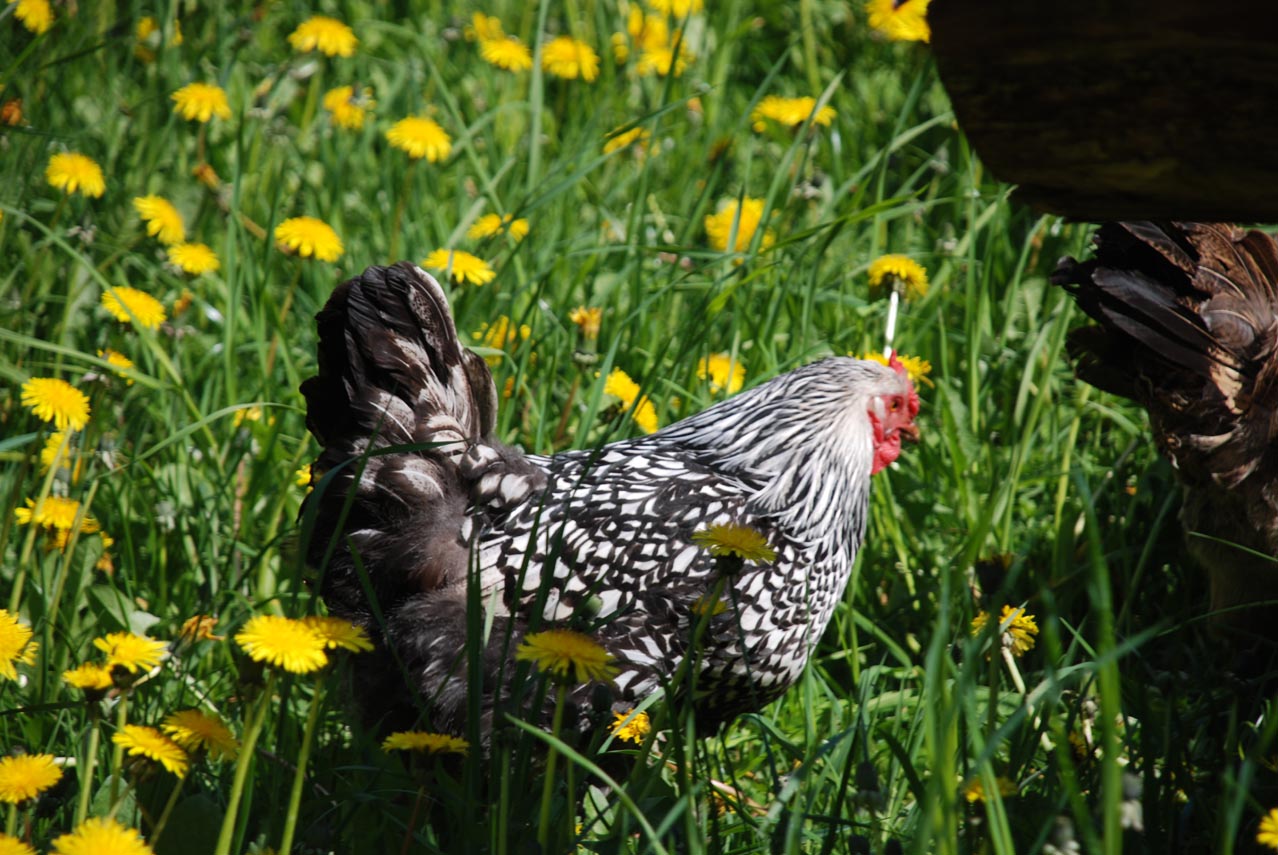
The sun finally came out for 3 days in a row, we all got out and followed it just like the dandelions.  I worked in the garden and let the chickens loose to enjoy the warmth of the sun.
Sierra, our great pyrenees is on her zip line doing chicken duty, she's on one side, and Summer, our golden retriever is on the other side of the meadow tied out.  Several days a week they work at guarding for 2 or 3 hours.  We like to let the chickens out to graze, for their overall health and the best quality eggs.  I notice a big difference in the color of the yolks when they are back on healthy pasture, rich golden orange yolks when on pasture, and the whites are a breeze to whip up.  I always whip the egg whites for omelette's, waffles and pancakes.
Rodney and the girls grazing, eating good bugs under the logs, they always find where the pickins are the tastiest.  The sunny weather makes me want to let the chickens and rabbits out to play in the sun too.  I learned valuable lessons my first years of letting animals loose, it draws in coyotes, neighbor dogs, and hawks.  The dogs have been our best defense, and of course a predator proof chicken coop and run. 

The dandelions in all their glory! Looking from the entrance of the chicken coop toward the big house.  This is a living meadow that has never had one ounce of chemicals put on it.  We mow several times per year, and have 3 meadows, we try to let the dandelions go as long as possible for the honeybees, and yet not too long they all go to seed.  Factor in a couple dry days to mow, either before the bees are out in the morning or mow after they have gone to bed.  During the height of the dandelion season, I can go to the beehives and watch the honeybees bringing in loads of dandelion pollen, and when you walk through the meadows, you see worker bees everywhere gathering nectar and pollen.  I watch many different types of insects go to the dandelion for food as well.  The rabbits and chickens also adore dandelion greens this time of year.  I enjoy them for their beauty and health giving qualities, how lucky we are to be so abundantly blessed!

Monday, February 14, 2011

free range chickens

This is Rodney our main rooster, he's just a barnyard rooster, meaning he's a little of this and a little of that.  When I asked the lady what kind of chicken he was when I picked him up from a very small family farm where he was hatched, she just said he was a barnyard rooster.  He's a very nice gentleman, and in the year we've had him he has never even attempted to threaten any of us.  We've had 2 roosters in the past that we raised from day old chicks that were so mean and nasty, I had to defend myself anytime they were loose, and the kids had to run for their lives.  Of course they thought it was funny and laughed and ran like crazy while being chased by a wild looking rooster.  If my children were small this would not have been funny, luckily they were all old enough to easily outrun them.  I also did my share of running and laughing, but the time one jumped at my face with his spurs coming at me was the time I decided to carry a large stick, after the first time of getting whacked hard by me, I got some respect.  For some reason, probably size and authority the mean roosters never did challenge Jarin.

I decided back then I would never live with a mean rooster again, so I put an ad on craigslist for a nice rooster wanted and got this one when he was only 6 months old.  The lady said all her roosters were nice, she had 3 of the most beautiful roosters, all barnyard ones.  He guards his girls, and will call them over excitedy when he finds a tasty morsel, he loves to dig and scratch for bugs and grubs and eat his greens.  He joins in the egg laying chorus everyday, the hen who's getting ready to lay will make a racket (song) and he joins in to create the egg laying melody. 
Henrietta is a Buff Orpington chicken, last year she went broody in the Spring and Fall, and produced some wonderful chicks, she fussed over her babies non-stop with a faithfulness few animals exhibit, she went out to pasture and free ranged with them when they were only a couple days old.  Both her and Rodney are some of our favorites, they've earned respect around here for good behavior.  I'm hoping Henrietta will go broody this spring, and when her chicks hatch out and are a day old, I can slip a couple banties, and silver laced wyandotte chicks under her to raise.  You can do that at night if they chicks are all the same age(one or two days old)the hen will raise them as her own.  This is so much easier than raising them in a stock tank with a light.  

Free range chickens are a dream I've always had, we have learned some very expensive lessons doing this the improper way, we now put dogs on chicken duty in their assigned spots, plus we are always within view and earshot, plus we go check anytime we hear the dogs barking.  One of the first areas they all migrate to is under the rabbit hutches, the tastiest spot for grubbing.


Tuesday, February 8, 2011

A Golden Egg

I remember well our first egg, we had all been watching for it, knowing it would be any day that our young chickens, called pullets would begin laying their first highly anticipated eggs.  This was a year and a half ago, and the hens were still in the basement of the coop, since the upper floor had yet to be finished.  We created a couple spots for them to be comfortable enough to lay an egg. 

It takes a hen about 5 months to begin laying, so when you get day old chicks in the Spring, you'll begin to get eggs around the first part of September.   The first egg your hens lay is really special, there has likely been a lot of money spent with no return, until now.  Those first five months, I remember well all the hard chickens lessons we learned.  No one can quite prepare you for it, as every situation is different.   Because we went through losing some right before they began laying, I was extra careful to make sure the 7 we had left were guarded closely.   

Raising chickens makes you aware of their vulnerability, and total reliance on your care.   They need to be fed, watered, and cleaned up after.  They also need to be guarded when you let them out to eat grass and free range.  They need a safe place to sleep on perches, and a good place to lay eggs and  make a nest.  If you have broody hens, they need a quiet corner to sit for several weeks, and baby chicks need to be protected from rodents, and kept extra safe at night.

That first year, we had to crawl under and look for eggs in the basement, we always kept it clean with fresh shavings or straw.  This is Tessa that first day she found an egg.

Ruby getting ready to lay an egg, in her nest box.

Kaley with our first egg, we were all so proud that day of our chickens, and that we had managed to keep some alive through those first 5 months to actually lay an egg.

Tuesday, January 4, 2011

The Rooster


This is Rodney our main rooster.  He will be allowed to grow old here at Applegarth, and will never have to fear being dinner.  I need one rooster who is a permanent resident.  We got Rodney about a year ago in February, I put an ad in Craigslist for a nice rooster wanted.  I received several responses, and chose a small local farm, that just had a few chickens.  He was hatched out in the fall on their farm, when one of their old hens walked out of their barn with 2 baby chicks following her.  All of her chickens were older and friendly, they had one old giant nice rooster, he had taught the 2 young chicks that turned into roosters how to be gentlemen.

The lady said I could have either one or both of the young roosters, she just didn't want them to be eaten, they were too special, and beautiful.  I told her we just wanted a nice one to add to the farm, for our 7 young hens needed a man. 

We brought him home to paradise, he went wild for few days with his young harem, courting, dancing and mounting.  The hens went from laying 1 or 2 eggs per day to laying 6 or 7, they were happy girls, and we had one happy contended rooster.

Sunday, January 2, 2011

New Experiences

This morning as I was cutting my son Jason's hair, we talked about the young rooster.  He had begun to breed the other hens, they also had Rodney our main rooster outside waiting for them wherever they went, 2 roosters is too many. Rodney was simply trying to protect his girls, and would get into squables with the younger one.  So we decided  today was the day.  I've always been brought the bird, cleaned and defeathered by my 16 year old son.  Well I decided to do it today, not the death part, but the scalding and plucking.  My son thought it was time I learned, and he took a few pic's along the way. 

If you only knew how this 6 month old rooster lived his happy life.  He got to be raised by Henrietta, the best chicken mom, he snuggled under her with his brother, and learned the ways of a chicken, he got to eat outside, and be fed as much as he wanted everyday, good scraps, plenty of water and fresh air.  He got to go grubbing, and eat grass, take dust baths everyday, and learned about chasing ladies, and courting.  It was a short beautiful life, and ended kindly.  We farmers live an honest life, we know where our food comes from, and  look them in the eye, and love their spirit, and the life they bring to our farm. 

We set up a table with a propane stove and large pot to boil the water for scalding.  Since there was snow on the ground.  I decided it would be most comfortable to just pluck right on the snow.  I dipped for about 30 seconds, and the feathers came out real easily, it did take time to get them all thoroughly out.  Then we cleaned out the innards, and I cleaned the chicken under cold water for a good while to get it real clean and chilled. We decided to slow boil and make soup, so the meat would be good and tender, so far I've added onions, carrots, celery and garlic. 

On a brighter note, I also baked up one of my Cinderella pumkins, picked from the garden in October, and made a pumpkin pie, this one has 6 eggs in it, and is sweetened with our own applegarth bees honey.  I love having food from our land, knowing that all the energy and love we put into the garden and animals, multiplies back to us with nutrition and health.   This is the good life to me.


Thursday, December 16, 2010

Pruning and Preening

This is the place to be seen, the girls all head out here after breakfast and make themselves beautiful.
They sit and watch the roosters strut around and chase each other, trying to win their affection.

Young Americana Hen

I have raised Thelma from a 1 day old chick. 
She lays beautiful green eggs.

Sunday, December 5, 2010

Farm and Garden


Meditating in the garden...This time of year as everything has totally died back, I enjoy looking at pictures from the summer and fall.  And I begin to dream about my garden coming back to life in the spring. 


Notice "Sierra" our great pyrenees laying down looking out of her new pasture.  This is the entry gate that Jarin built in October for her new 1 acre pasture.  She is 1 year old purebred Great Pyrenees. and if let loose will wander off  and explore for miles around.  She will return, but the responsible owners of this breed will understand the need to be fenced or on lead, until they are mature enough to not want to wander, this may take 4 or 5 years.  They are wonderful livestock guardian dogs, when they are fenced with the animals.  This is my my husband Jarin's dog, and she goes everywhere with him.  Someday when we get milk goats they will share this pasture with her, along with another one that will be their paddock off the barn.


The chickens get to free range several times a week, they go all over the upper pasture, and stay in range of the chicken coop, I imagine so the hens can go back throughout the day to lay their eggs.  They love to eat all different types of grasses, weeds, and bugs.  The favorite place to scratch under is the rabbit hutch.  I guess thats where the best bugs are.  The trees surrounding our property are large douglas fir, hemlock alder, cedar, wild cherry, some grand fir, and noble fir.  Back when Jarin bought this land 30 years ago this was an old christmas tree farm.  The trees have grown over the years, and he has cleared the  upper and lower meadows.  Milling up the good logs for timbers to build with.  Or the alder and hemlock for firewood.  He doesn't build with hemlock ever, mostly douglas fir because it has more integrity. 


Henrietta gets the best mom award in our coop, she has raised 2 sets of babies last Spring and this Fall.  It is a delight to watch her and her chicks.  They obediantly follow her around, and she clucks to them to come for food.  She makes sure they are tucked in every night all cozy under her feathers.  As they get older she is still next to them teaching them always how to be a good chicken, and what to do.  They have to learn how to stay out of the way of Rodney the rooster, and the dominant hens.  They have to watch out for any chicken that has a higher rank than them.  It is interesting to watch the whole dynamic within the flock.  They all accept the baby chicks, and are curious to check them out when she first ventures out after 21 days of sitting on the eggs.  After raising chicks with a light, and letting the mom raise them.  I will vote for lettin the mom raise them everytime.  It's much easier that way.  They have a mom to take care of them, and don't seem like little orphans.


This photo was taken around the beginning of October, I had already taken the supers off, and have sugar syrup on for the fall medicated feeding.  I use fumigilan B to treat for nosema.  Any frames that came off the supers and had honey on them, I extracted.  This was a good year for honey, I got both light early  honey, and dark later honey.  Around here our honey is made mostly from blackberry, and wild flowers. 

Some of the frames didn't have the caps fully sealed over, so I set those out in front of the hives this time of year, and they totally clean them up of every drop of honey, and take the food in the deep hive bodies to be stored for winter.  You need to leave approximately 60 lbs of honey for the bees to last through the winter.  That's 2 deep hive bodies.  At the end of Fall I take off the top box with sugar syrup, and wrap the hive bodies, put a cover over the top, and a mouse guard on the entrance.  They will stay in the winter cluster usually  from around the third week of November until a beautiful sunny/mild day around the 3rd week of January.  They will come out then for cleansing flights to go to the bathroom, and stretch their bodies. 

The bees are the lifeblood in my garden, I love the hum of energy they bring to every fruit and flower.  They are busy little workers, and always interesting to watch.  I have spent many hours studying them, and what they are gathering and bringing into the hive.  I have had bees now for 4 years, and will have to spend some time, and write and share all of the hard lessons I've learned from trial and error.  To be a good beekeeper takes time and money.  There is a learning curve to be sure, queens, drones, pollen, propolis, swarming, starvation, adding supers, mites, and nosema.  You will want to read and study up on beekeeping before getting them.  Once you have them, you will never want to be without bees, and your own honey, and pollinators.

My favorite plant I grew this year was Amaranth or Love Lies Bleeding.  I bought heirloom seed for all my vegetables from Baker Creek Heirloom Catalog.  I have been very happy with all the seeds this year, well except for the tomatoes, which none ripened, but that wasn't the seed companies fault.  That was our cool summer, and not having the heat to ripen them. I have tried to save as many varieties of seed as I can this year.    The amaranth is still laid out drying, and I will be threshing it soon for amaranth grain, and will add it to breads I make.